

Performance Analysis
/Sharpe Ratio Calculator Guide
Sharpe Ratio Calculator Guide
Learn how to configure the Sharpe Ratio Calculator and interpret its rolling chart, ranks, and comparison outputs.
The Sharpe Ratio Calculator measures how much excess return a portfolio generated for each unit of total volatility.
This guide explains how to configure the calculator and read each output. For the formula, interpretation, and limitations of the metric itself, see Sharpe Ratio Explained.
High absolute return can be misleading if volatility is also high. Sharpe Ratio helps assess return quality relative to total risk.
How to Use the Tool
Use this workflow in Sharpe Ratio:
1
Select Portfolio Positions
Create or choose your portfolio in the selector.
2
Choose Benchmark
Set benchmark for context in comparative plates.
3
Configure Risk-free Rate
Use US Money Market Yield (^CASHX) or switch to custom annual rate.
4
Set Lookback Period
Choose rolling window length based on your analysis horizon.
5
Calculate and Review Outputs
Run calculation and evaluate chart, ranking, and percentile context.
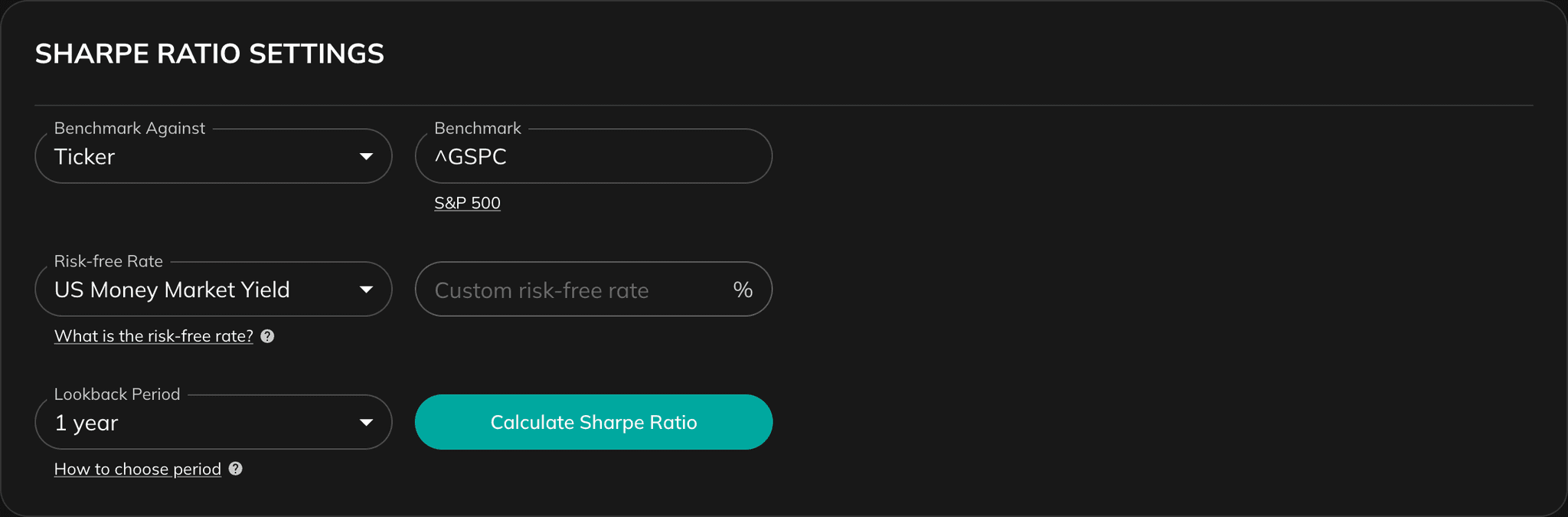
Tool Settings
Benchmark
Adds a separate benchmark series and benchmark indicators for comparison. It does not enter the portfolio Sharpe Ratio formula.
Risk-free Rate Source
Choose historical US Money Market Index (^CASHX) returns or a custom fixed annual rate.
Custom Risk-free Rate
Enter the annual percentage deducted from annualized portfolio return in every calculation window.
Lookback Period
Sets the calendar-based rolling window used by the historical chart, from 30 days to 10 years.
The default settings use ^CASHX, a one-year rolling window, and your selected default benchmark. A custom rate of 0% measures annualized return per unit of volatility without subtracting a risk-free return.
Results: Section-by-Section Guide
Sharpe Ratio Chart
The chart recalculates Sharpe at each date using the selected rolling window. It plots the portfolio, its positions, and the selected benchmark when sufficient overlapping data is available. Changing the lookback changes this chart, but not the fixed-period values in the results table.
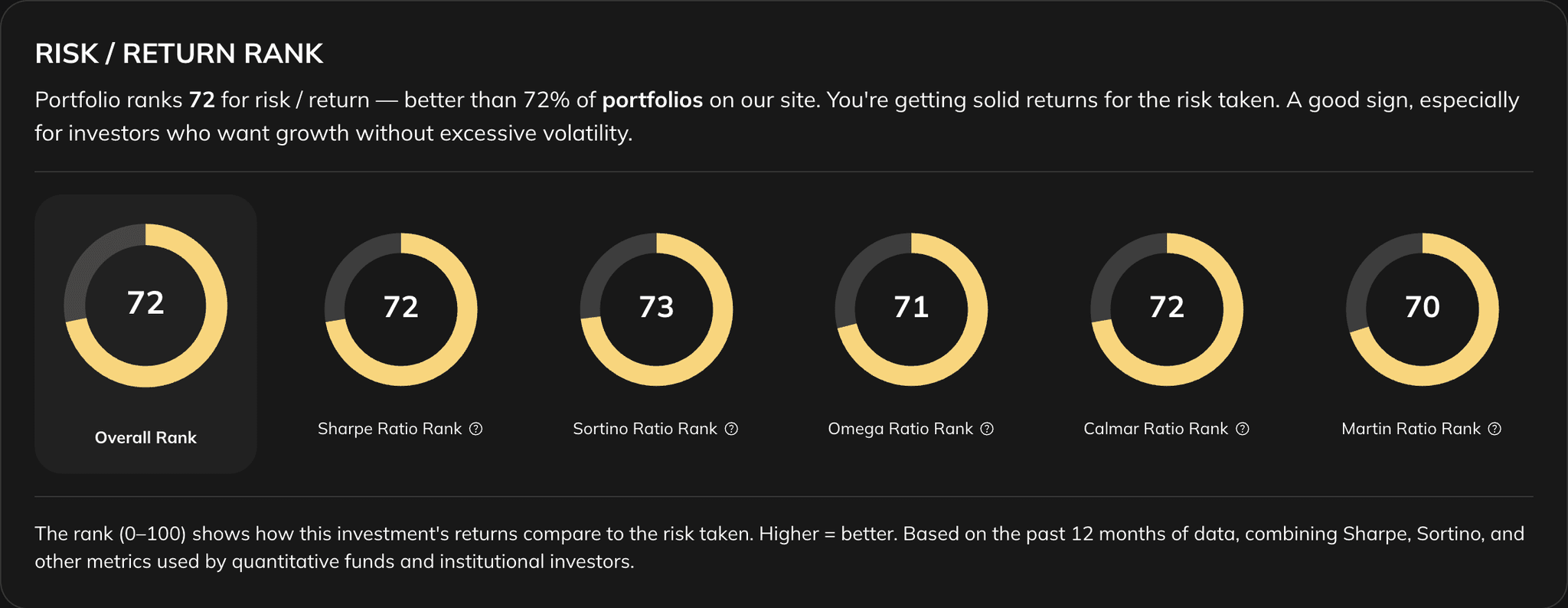
Portfolio Risk-Adjusted Rank
The PortfoliosLab Risk / Return Rank uses a weighted average of the Sharpe, Sortino, Omega, Calmar, and Martin percentile ranks. See the methodology guide for its peer groups, supported periods, and interpretation.
Risk-Adjusted Returns Table
The table reports Sharpe and complementary risk-adjusted metrics for the portfolio, benchmark, and individual positions. Use the period selector to compare trailing 1Y, 5Y, 10Y, and inception values. Ranks are available for 1Y, 5Y, and 10Y; inception values are not ranked.

Distribution Percentile Context
The calculator page also shows trailing 1Y Sharpe distributions for portfolios, equities, and ETFs. These percentile ranges are separate peer-group references, so compare a portfolio with portfolios and an ETF with ETFs rather than applying one universal “good Sharpe” threshold.
Best Practices
Use consistent risk-free assumptions
Compare results calculated with the same rate source, period, and return frequency.
Separate rolling and fixed-period results
Use the chart to inspect changing regimes and the table to compare standardized periods.
Compare like with like
Use the benchmark and peer ranks for context instead of relying on a universal threshold.
Check what Sharpe can miss
Review drawdown, Sortino, and Omega alongside Sharpe; see Sharpe Ratio Explained for practical caveats.
Exact Calculation Methodology
PortfoliosLab uses the following calculation for each return series:
Sharpe Ratio = (annualized compounded return - annualized risk-free return) / annualized standard deviation
The calculation follows these steps:
- Build the return series. Security returns come from split- and dividend-adjusted closing prices. Portfolio returns apply the selected allocations, reporting currency, and rebalancing rules before Sharpe is calculated.
- Compound the return. Returns inside the calculation window are compounded, then annualized using the number of observations and the detected data frequency.
- Annualize volatility. PortfoliosLab calculates the population standard deviation of periodic returns and multiplies it by the square root of the detected periods per year. The frequency can be annual, quarterly, monthly, weekly, trading-daily, or calendar-daily.
- Subtract the risk-free return. A custom rate is treated as a fixed annual rate. With
^CASHX, its daily returns over the same dates are compounded and annualized separately for each window. - Divide excess return by volatility. If volatility is zero, the result is not reported because the ratio is undefined.
The rolling chart supports 1-month, 3-month, 6-month, 1-year, 2-year, 3-year, 5-year, and 10-year lookback periods. A point appears only after a full window is available, so each point answers: “What was the annualized Sharpe Ratio over the selected period ending on this date?”
Your risk-free choice applies to the portfolio and benchmark everywhere it appears. Individual position rows in the results table are the exception: they use precomputed symbol indicators that always assume a 0% risk-free rate, so a position's standalone value there will not match a calculation that subtracts a risk-free return.
This is one valid Sharpe Ratio methodology, not the only one. Other sources may use average instead of compounded returns, a different data frequency, another risk-free rate, or sample rather than population standard deviation. Small differences from Morningstar, Yahoo Finance, or your broker are therefore expected and do not indicate an error.
The selected lookback controls the rolling chart. The risk-adjusted table and ranks are calculated separately over fixed trailing 1Y, 5Y, and 10Y periods, with an additional inception value where available.