

Performance Analysis
/Stock Comparison Tool Guide
Stock Comparison Tool Guide
Learn how to compare two symbols side by side across performance, risk-adjusted return quality, drawdowns, volatility, and fundamentals.
Stock Comparison helps you compare two symbols in one consistent framework instead of checking separate pages and trying to interpret differences manually.
This tool is useful when you need to choose between two candidates for the same portfolio role, such as two ETFs in one category or two equities from a similar sector.
Two symbols can have similar headline returns but very different risk profiles, downside behavior, expense structure, and fundamentals. Stock Comparison makes those trade-offs visible in one place.
How to Use the Tool
Use this workflow in Stock Comparison:
1
Select Two Symbols
Open the comparison page with two tickers (for example: `/tools/stock-comparison/AAPL/MSFT`).
2
Set the Return Hurdle
Enter an annualized risk-free rate or Minimum Acceptable Return (MAR). Keep 0% to use the default absolute-return comparison.
3
Start with Performance
Review growth behavior, key characteristics, and returns by period to understand long-term and regime-specific differences.
4
Validate Return for Risk
Use risk-adjusted rankings and metric comparisons (Sharpe/Sortino/Omega/Calmar/Martin context) to evaluate return efficiency.
5
Check Downside and Stability
Compare drawdowns and volatility to evaluate stress behavior and holding difficulty during downturns.
6
Use Conditional Sections
Review dividends when supported, and financials/profitability/valuation when both symbols are equities.
The Risk-free rate / MAR setting applies one consistent annual hurdle across the return-for-risk results. Sharpe, Calmar, and Martin subtract it from annualized return, while Sortino and Omega use it as the MAR threshold for downside returns. The same value also drives the rolling Sharpe chart.
Compare like-for-like candidates. Results are more actionable when both symbols serve a similar role in your portfolio.
What the Tool Covers
The comparison combines multiple layers:
Performance Block
Growth chart, currency context, key characteristics, fundamentals summary, returns by period, and expense ratio.
Return for Risk
Risk-adjusted rank, comparative return-for-risk chart, and indicator breakdown with Sharpe context.
Correlation
Direct correlation score with diversification interpretation.
Dividends (conditional)
Appears for EQUITY, ETF, and MUTUALFUND pairs when dividend comparison is relevant.
Drawdowns
Losses from prior highs for both compared symbols.
Volatility
Rolling one-month volatility comparison and risk interpretation.
Financials / Profitability / Valuation (equity-only)
Additional fundamental sections that appear when both symbols are equities.
Results: Section-by-Section Guide
1. Performance
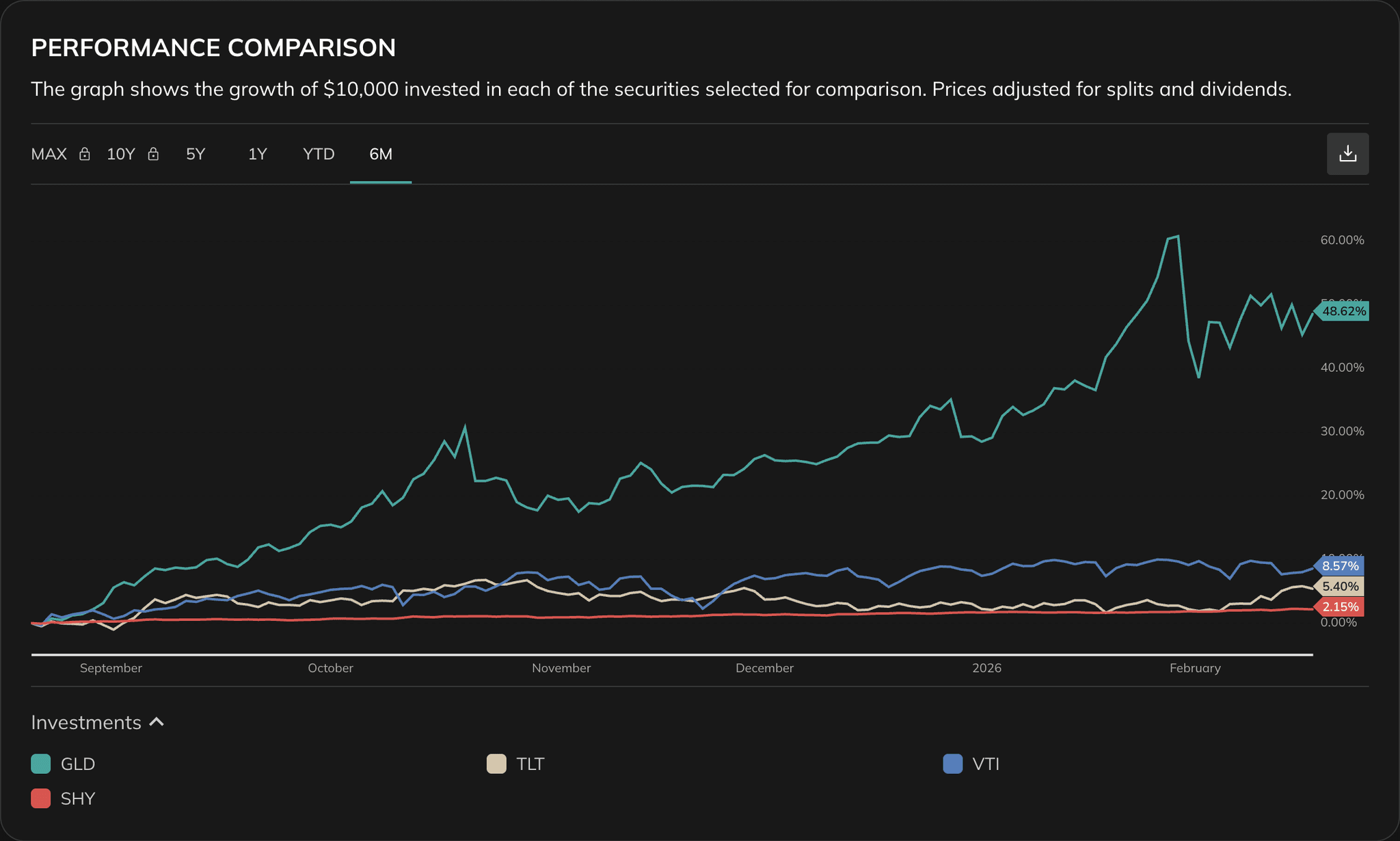
This section shows how a hypothetical equal-start investment evolves for both symbols, with dividend-adjusted behavior when applicable.
It also includes supporting blocks used in practical decision-making:
- Key characteristics
- Fundamentals summary (when available)
- Returns by period
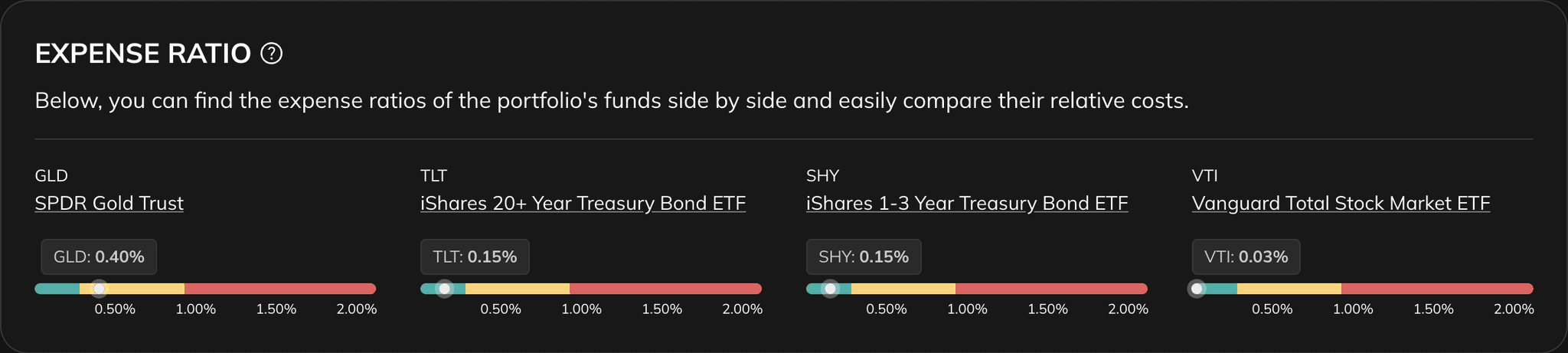
- Expense ratio comparison (where relevant)
Expense ratio Cost drag that affects long-term compounding. A fund's expense ratio is the annual fee—expressed as a percentage of its allocation in an investor's portfolio—that the fund charges for its management and operation. Lower expense ratios generally result in higher net returns for investors.
2. Return for Risk
This section tests whether return is earned efficiently for risk taken.
The Risk / Return Rank combines the percentile ranks of five risk-adjusted metrics. Each selected symbol is ranked within its own asset-type peer group.
Use it to compare:
- Risk-adjusted rank within each symbol's peer group
- Comparative return-for-risk metrics
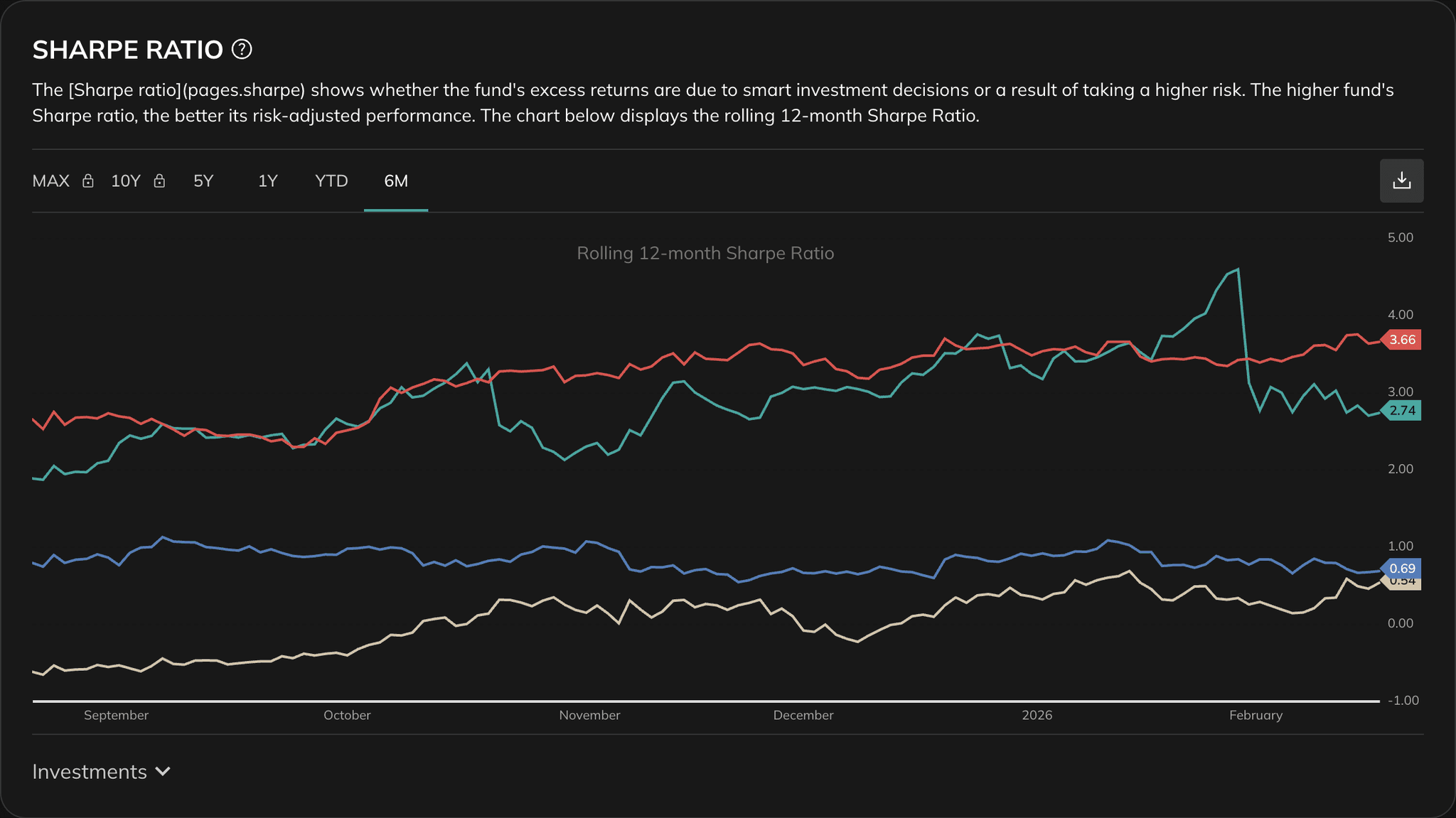
- Indicator context, including Sharpe behavior

Sharpe Ratio
3. Dividends (when available)
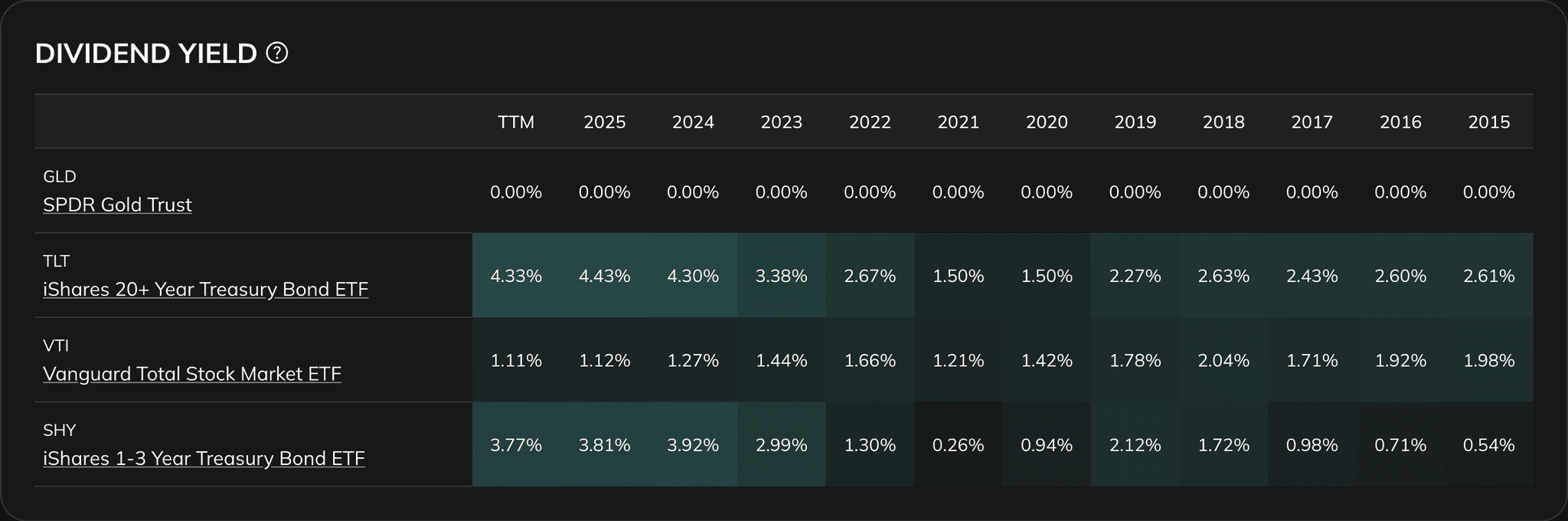
The dividend yield represents the profit an investor would have received if they had held the investment over the specified period. It is calculated by dividing the sum of any income distributions during that period by the market price at the end of the period.
4. Drawdowns
Drawdown is a risk measure that shows how deep an asset or portfolio has fallen from its maximum and how long it has taken to recover.
Use this section to evaluate how severe losses get and how long recovery takes.
Read the Drawdowns tool documentation for more details.
5. Volatility
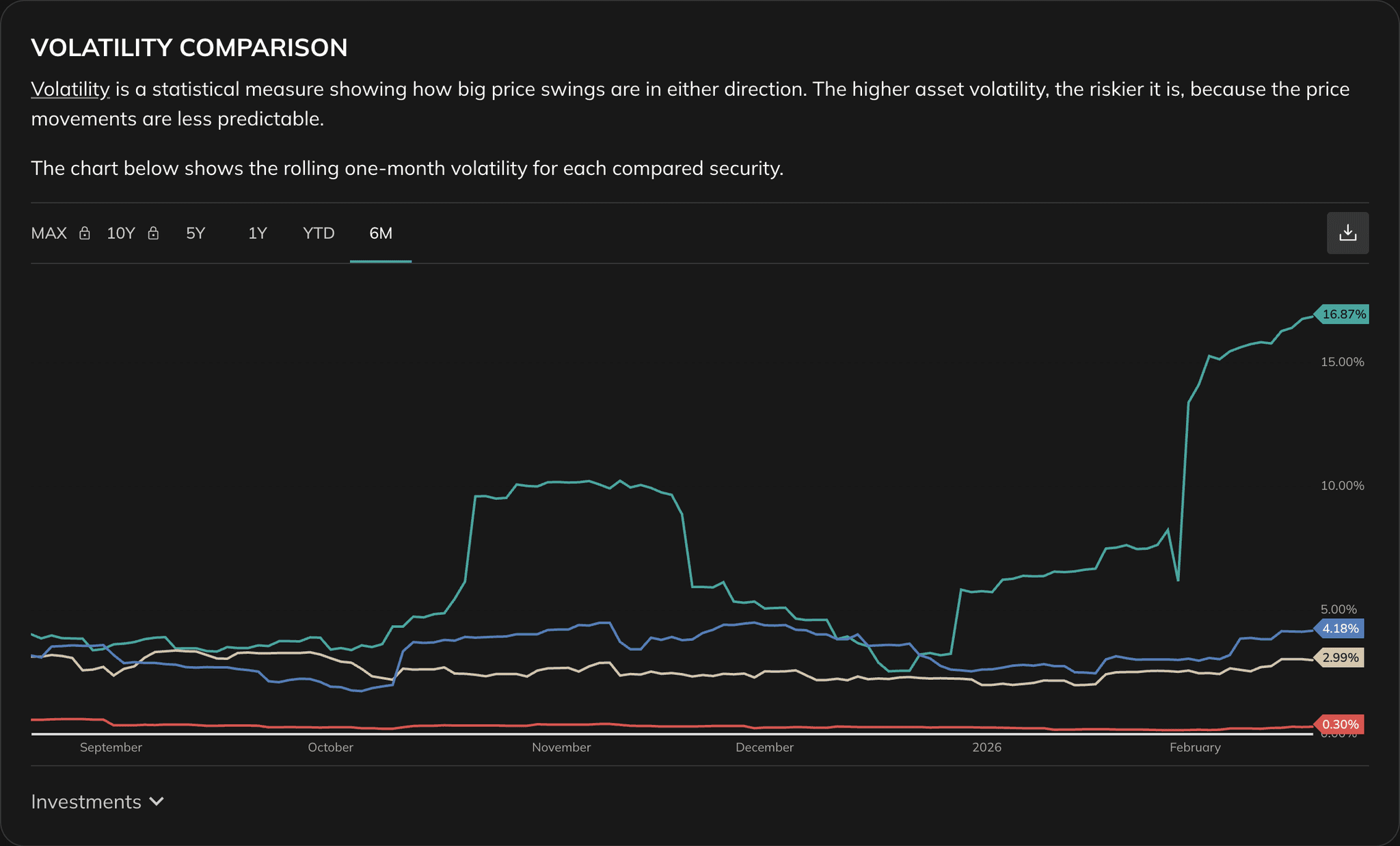
Volatility measures return variability and risk stability over time. See Understanding Volatility for a detailed explanation of what volatility means and how it affects portfolio behavior.
Watch for:
- Regime shifts in volatility level
- Prolonged high-volatility windows
- Alignment between realized volatility and your risk tolerance
Prefer the symbol that best fits your portfolio objective and risk budget, not necessarily the one with the highest standalone return.
6. Correlation
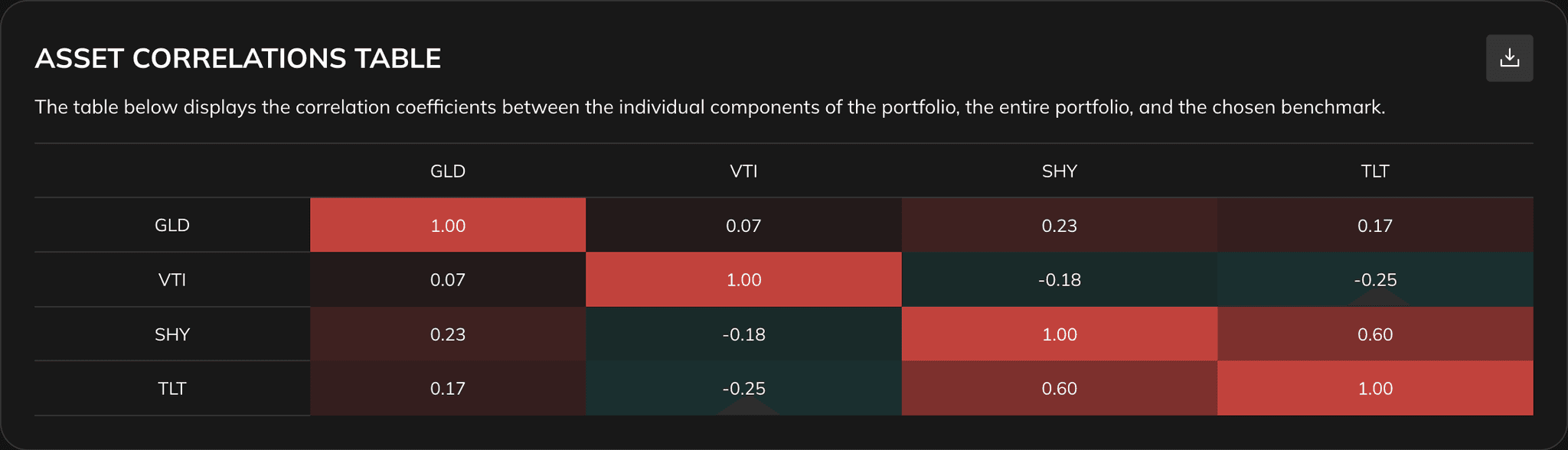
When multiple assets are present, this section helps assess diversification quality via correlation.
Interpretation guidance:
- High positive correlation suggests limited diversification benefit
- Low or negative correlation can improve diversification potential
Example
Suppose you compare two stocks for a long-term growth allocation:
Stock A shows higher total return, but noticeably deeper drawdowns and higher volatility during stress periods. Stock B shows slightly lower total return, but a smoother performance path and stronger risk-adjusted profile.
If your goal is more stable compounding and easier hold behavior during market shocks, Stock B may be the better portfolio choice even without the highest headline return. This is the practical value of Stock Comparison: it highlights trade-offs clearly.
Best Practices
Comparing unlike assets
Conclusions are weaker when symbols have very different structures or portfolio roles.
Focusing only on return
Always pair return with drawdowns, volatility, and risk-adjusted quality.
Ignoring correlation
Two strong standalone symbols can still combine poorly if they move together.
Skipping conditional sections
For equity pairs, include Financials, Profitability, and Valuation before final decisions.