

Risk Analysis
/Beta
Beta
Learn how to measure market sensitivity and portfolio risk profile with the Beta tool.
Beta measures how strongly your portfolio tends to move relative to a selected benchmark.
It answers a core risk question: how much market exposure are you taking to produce your returns?
Two portfolios can show similar returns, but the one with much higher Beta usually carries larger downside pressure during market declines.
How to Use the Tool
Use this workflow in Beta:
1
Select Portfolio Positions
Build or choose the portfolio you want to analyze.
2
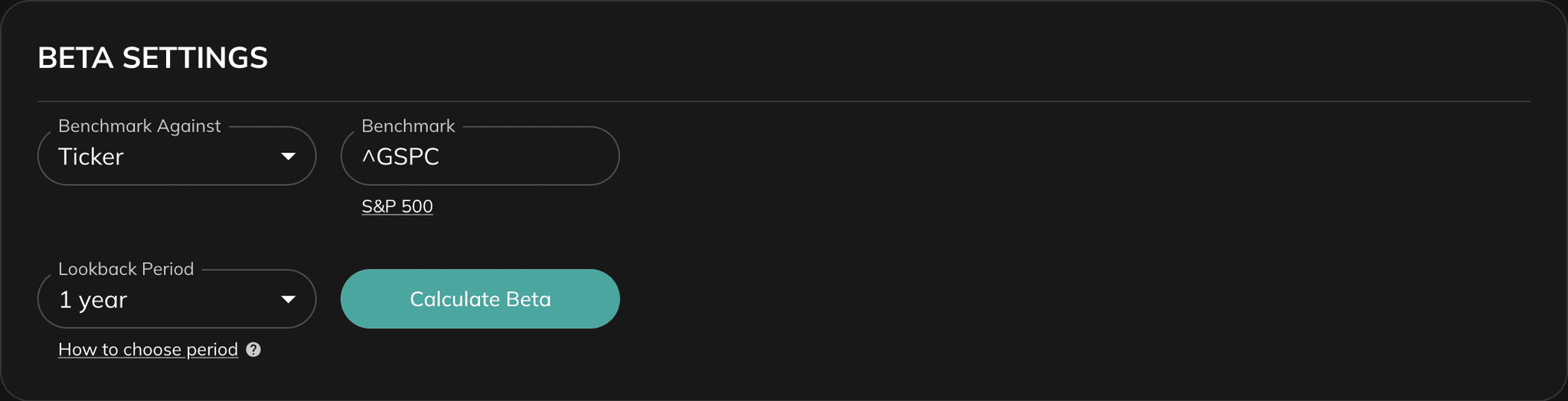
Choose a Benchmark
Select the market reference your portfolio should be compared against.
3
Set Lookback Period
Pick a rolling window from 1M to 10Y depending on whether you need short-term sensitivity or long-term structure.
4
Calculate Beta
Click "Calculate Beta" to generate rolling Beta and related Alpha charts.
5
Read Sensitivity and Skill Together
Use Beta for market sensitivity and Alpha as supporting context for benchmark-adjusted excess return.
When changing benchmark, re-check Beta interpretation from scratch because Beta values are benchmark-dependent.
Tool Settings
The Beta tool has the same key controls as Alpha:
- Benchmark — Defines the market used to estimate co-movement and sensitivity.
- Lookback Period — Sets the rolling window length. Short windows react quickly; long windows provide more stable trend context.
Lookback interpretation:
- Short periods (up to 6 months): useful for recent regime shifts, but noisier.
- Medium periods (6 to 12 months): balanced for tactical and strategic review.
- Long periods (more than 12 months): better for structural risk profile analysis.
If required inputs are missing (for example, invalid positions or no benchmark), calculation is blocked until validation issues are resolved.
Results: Section-by-Section Guide
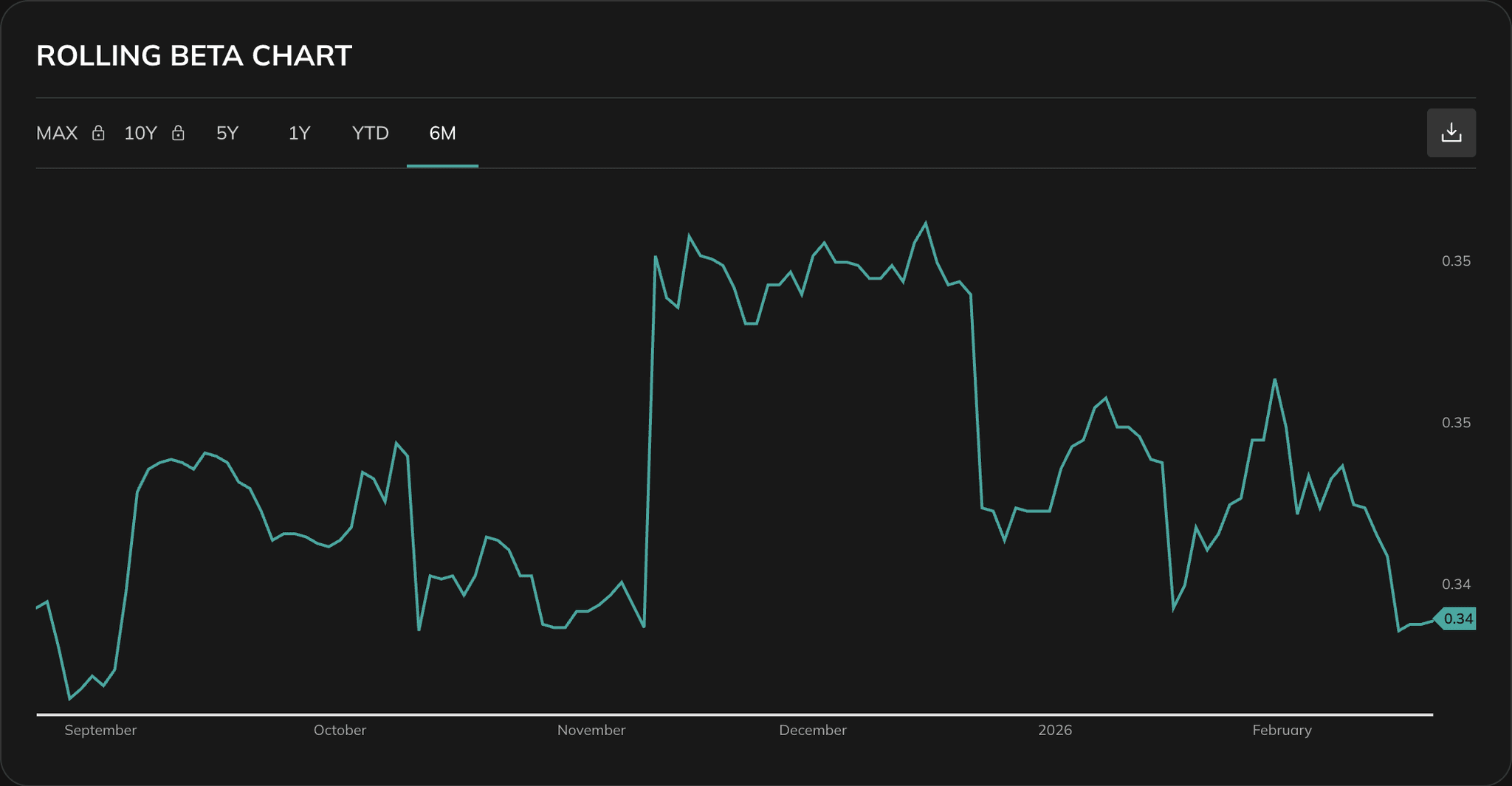
1. Rolling Beta Chart
This is the main section. It shows how your portfolio's sensitivity to benchmark movements changes over time.
Typical interpretation:
- Beta > 1: portfolio usually moves more than the benchmark (higher sensitivity)
- Beta = 1: portfolio generally tracks benchmark move magnitude
- Beta between 0 and 1: portfolio usually moves less than benchmark
- Beta < 0: portfolio tends to move opposite to benchmark direction
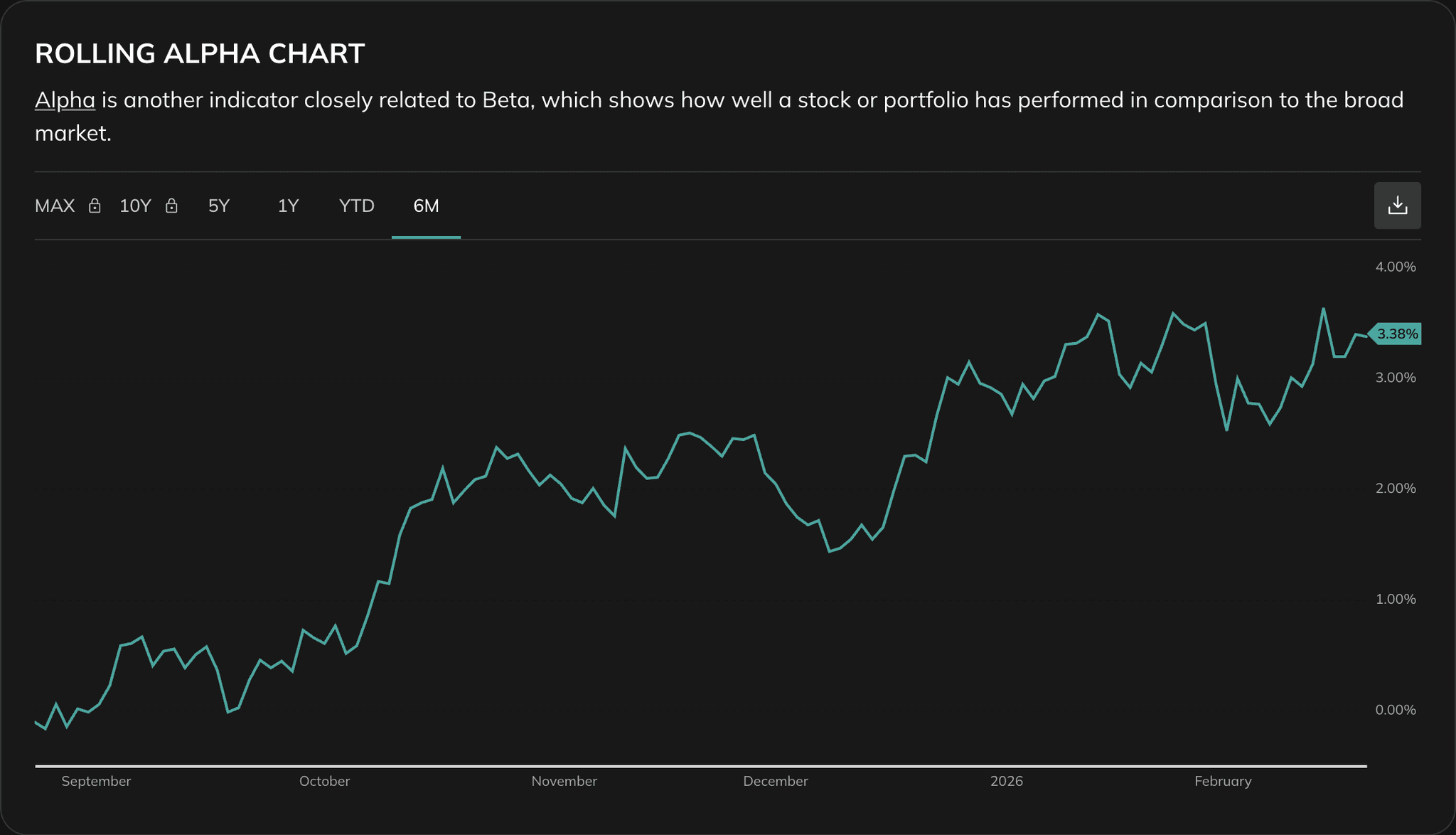
2. Rolling Alpha Chart (Related)
This companion view shows whether returns above or below expected benchmark-adjusted behavior were generated while Beta changed.
Use it to understand:
- whether low Beta is achieved with positive or negative Alpha
- if high Beta periods also produced real excess return
- whether risk-taking was compensated by better benchmark-adjusted outcomes
A lower Beta is not automatically better. The right Beta depends on your objective, time horizon, and whether Alpha quality supports the risk profile.
Example
Suppose two portfolios use the same benchmark over a 1-year lookback:
Portfolio A has a rolling Beta averaging 1.35 and experiences larger swings during market stress. Portfolio B has a rolling Beta averaging 0.75 and shows a smoother risk profile with smaller benchmark-linked moves.
If your objective is capital preservation and easier hold behavior in volatile markets, Portfolio B may be more suitable even if headline return is slightly lower in strong bull phases.
Best Practices
Match benchmark to strategy
An unrelated benchmark can make Beta interpretation misleading.
Track Beta stability over time
Regime shifts matter more than a single average Beta value.
Pair Beta with Alpha
Check whether market sensitivity is rewarded by benchmark-adjusted excess return.
Align Beta with risk budget
Choose sensitivity level based on drawdown tolerance and portfolio role.
See also: Alpha, Treynor Ratio