

Risk Analysis
/Drawdown Analysis
Drawdown Analysis
Learn how to measure downside risk, compare portfolio resilience, and understand recovery time after losses with the Drawdowns tool.
Drawdown is the percentage decline from a portfolio peak to a subsequent trough. If a portfolio drops from $10,000 to $8,000 before recovering, that is a 20% drawdown.
In the Drawdowns tool, drawdowns are displayed as losses from prior highs over time, helping you evaluate not only how deep losses were, but also how long recovery took.
Drawdown analysis helps you:
- Assess downside risk from historical behavior
- Compare your portfolio against a selected benchmark
- Evaluate whether current risk fits your time horizon and tolerance
- Understand how difficult it can be to recover after losses
Two portfolios can have similar long-term returns but very different drawdown behavior. A portfolio with shallower and shorter drawdowns is often easier to hold during market stress.
How to Use the Tool
Use this workflow in Drawdowns:
1
Select Portfolio Positions
Choose the assets and weights you want to analyze in the portfolio selector. The tool validates positions before calculation.
2
Choose a Benchmark
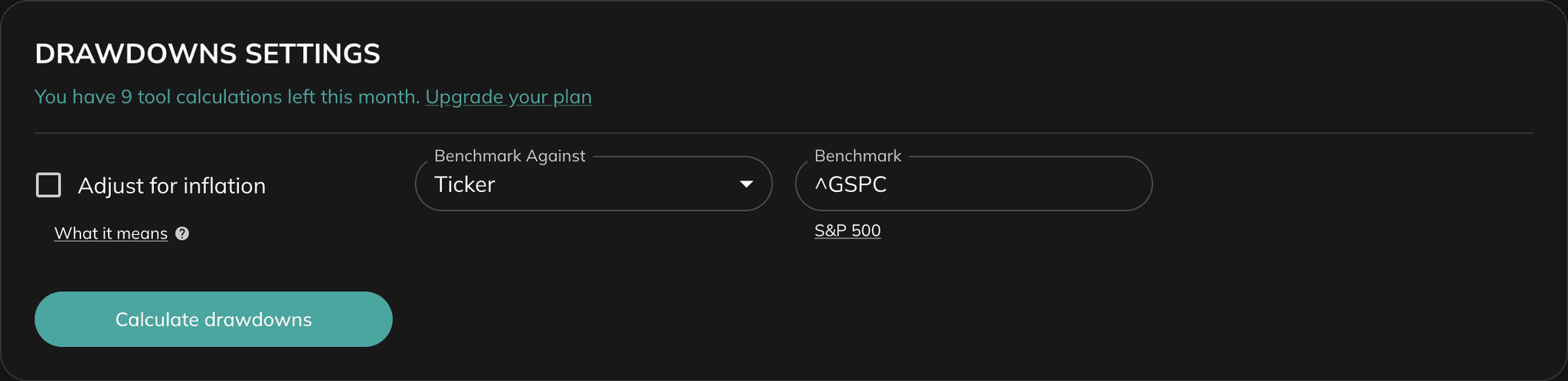
Select the benchmark index or asset used for comparison. This helps you evaluate whether your portfolio drawdowns are better or worse than a reference market.
3
Set Inflation Adjustment
Enable inflation adjustment if you want drawdowns calculated in real (inflation-adjusted) terms instead of nominal terms.
4
Run Calculation
Click "Calculate drawdowns" to generate the drawdowns chart and the worst drawdowns table.
5
Review Risk Profile
Use the chart for visual stress periods and the table for exact drawdown depth, duration, and recovery details.
Run the analysis after major market moves, portfolio rebalancing, or allocation changes to verify that downside risk remains acceptable.
Tool Settings
The Drawdowns tool has two primary settings:
- Adjust for Inflation — When enabled, portfolio performance and drawdowns are evaluated in real terms rather than nominal terms.
- Benchmark — Defines the comparison baseline. Benchmark drawdowns help you judge whether your portfolio is more defensive or more volatile than the chosen market reference.
Inflation Adjustment
When you adjust for inflation, your portfolio's performance is evaluated in real terms, rather than nominal terms.
- Nominal performance reflects the raw returns without accounting for the impact of rising prices over time.
- Real performance adjusts these returns to remove the effects of inflation, giving you a clearer picture of your portfolio's actual purchasing power.
This adjustment helps you understand whether your investments are truly growing in value or merely keeping pace with inflation.
Example:
If your portfolio grows by 5% in a year, but inflation is 3%, the real growth is only 2%. Similarly, if your portfolio loses 2% in a year, but inflation is 3%, the real drawdown is 5%.
By enabling this option, you ensure your portfolio's performance is measured more accurately, helping you make better investment decisions.
If required inputs are missing (for example, invalid positions or no benchmark), the tool surfaces validation errors before running calculations.
How to Read the Results
Drawdowns Chart
The chart displays portfolio losses from any high point along the way and supports benchmark comparison.
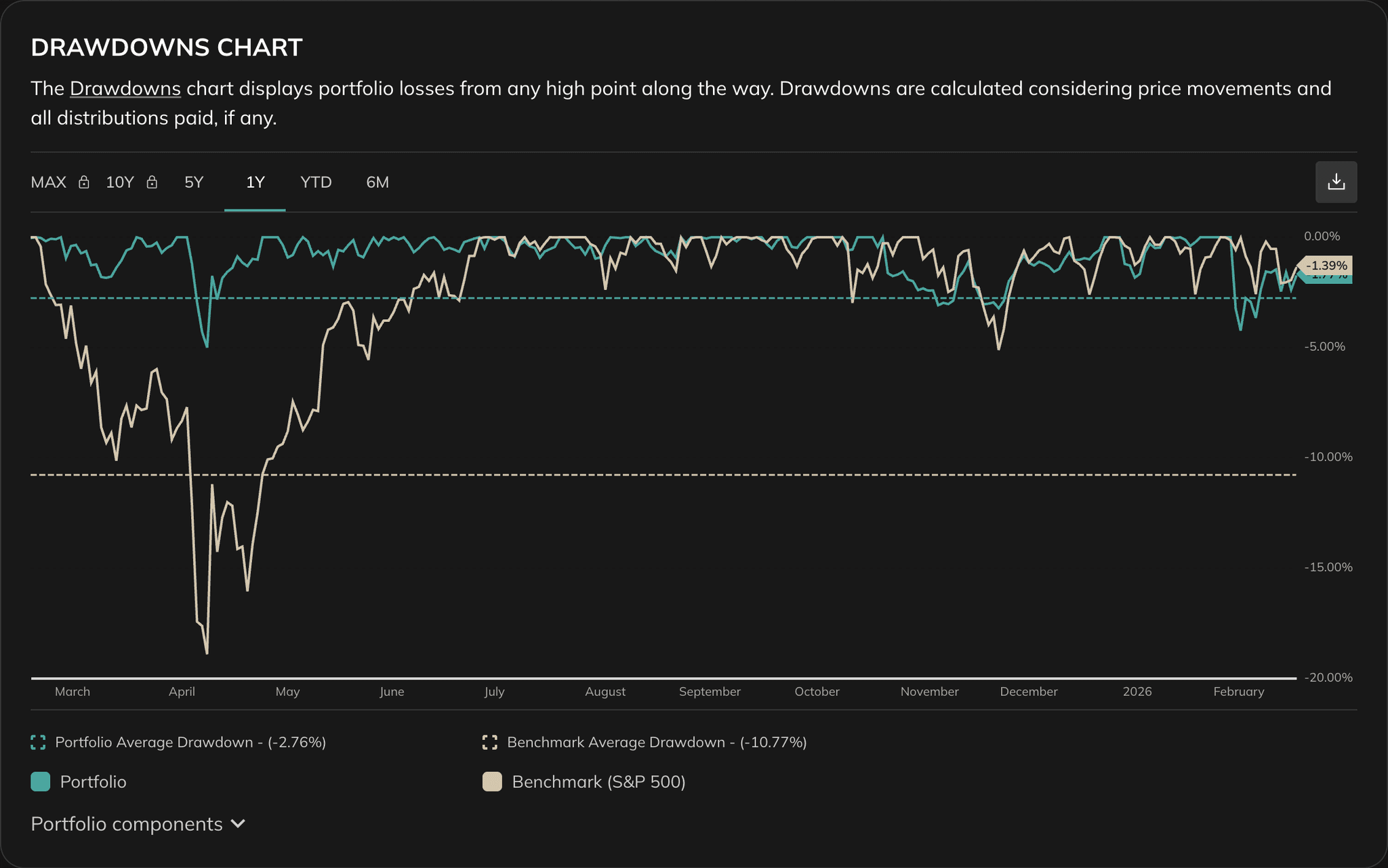
- When major stress periods occurred
- How deep each decline was
- Whether drawdowns were frequent or isolated
- How portfolio drawdowns compare with benchmark drawdowns
- Average drawdown levels for portfolio and benchmark
Worst Drawdowns Table
The table provides detailed drawdown episodes and timing metrics:
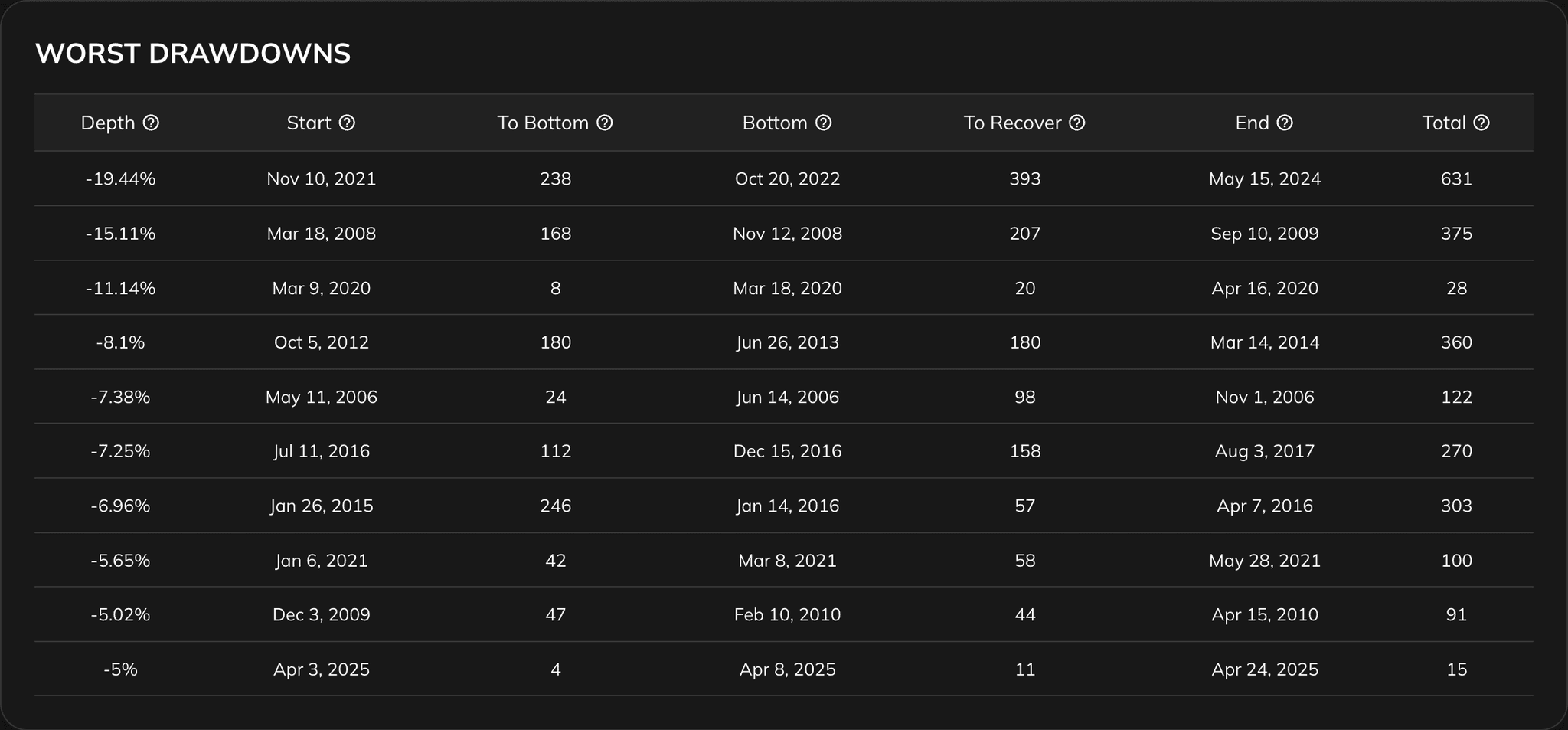
Depth
The percentage between the peak and the subsequent trough.
Start
The beginning date of the drawdown period.
To Bottom
The number of trading sessions it took to reach the trough.
Bottom
The date when a drawdown reached its trough.
To Recover
The number of trading sessions it took to recover.
End
The end date of the drawdown period (if recovered).
Total
The number of trading sessions it took for a loss to regain its initial value.
Depth tells you how severe losses were; To Bottom, To Recover, and Total show how long pressure lasted. Evaluate magnitude and time together.
Example
Suppose two portfolios both start at $10,000 and both deliver similar long-term return, but they behave differently during a market shock:
Portfolio A falls from $10,000 to $7,500 (drawdown: -25%) and recovers to the previous peak in 4 months. Portfolio B falls from $10,000 to $6,000 (drawdown: -40%) and needs 14 months to recover.
Even if total return after several years is close, the investor experience is very different:
- Portfolio A is usually easier to hold through stress.
- Portfolio B requires higher emotional tolerance and a longer recovery wait.
- The deeper the loss, the harder the recovery (a 40% loss needs a much larger gain to break even than a 25% loss).
This is why drawdown analysis is useful: it helps you choose portfolios you can realistically stick with in difficult market periods, not just portfolios that look good in average-return terms.
Best Practices
Compare against relevant benchmarks
Try benchmarks that match your portfolio style to make comparisons more meaningful.
Track both nominal and real drawdowns
Inflation-adjusted analysis can change your view of long drawdown periods.
Review drawdowns after portfolio changes
Re-check drawdown depth and recovery dynamics after rebalancing or large allocation shifts.
Pair with complementary risk tools
Use Drawdowns together with Value at Risk and Expected Shortfall for a broader downside-risk picture.
See also: Value at Risk, Expected Shortfall