

Performance Analysis
/Calmar Ratio Calculator Guide
Calmar Ratio Calculator Guide
Learn how to evaluate return efficiency against maximum drawdown with the Calmar Ratio tool.
The Calmar Ratio Calculator compares annualized excess return to maximum drawdown over a selected period.
Compared with Sharpe-like metrics, Calmar uses drawdown instead of volatility as the risk denominator. For many investors, this makes interpretation more intuitive because maximum drawdown directly reflects worst peak-to-trough loss.
A portfolio can show strong return but still be hard to hold if drawdowns are deep. Calmar Ratio helps quantify whether return quality is high relative to worst downside.
How to Use the Tool
Use this workflow in Calmar Ratio:
1
Select Portfolio Positions
Build or choose your portfolio in the selector.
2
Choose Benchmark
Set a relevant benchmark for context and comparison in supporting plates.
3
Set Risk-free Rate and Lookback
Define annualized risk-free rate and the rolling lookback window.
4
Calculate Calmar Ratio
Click "Calculate Calmar Ratio" to generate chart and comparison plates.
5
Interpret Chart with Ranking Tables
Read rolling behavior together with rank and risk-adjusted comparison table.
Tool Settings
The tool uses three main settings:
Benchmark
Reference context for relative interpretation and comparison plates.
Risk-free Rate
Annualized baseline return subtracted from portfolio return in numerator.
Lookback
Rolling-window length used for return and drawdown computation.
Results: Section-by-Section Guide
1. Rolling Calmar Ratio Chart
Shows how return-to-drawdown efficiency changes over time.
Interpretation guidance:
- Negative values: excess return is below risk-free baseline; limited practical signal.
- 0 to 1: return does not exceed drawdown meaningfully.
- Above 1: return exceeds drawdown; quality improves as value rises.
- Around 3 and above: often indicates very strong return relative to worst downside.
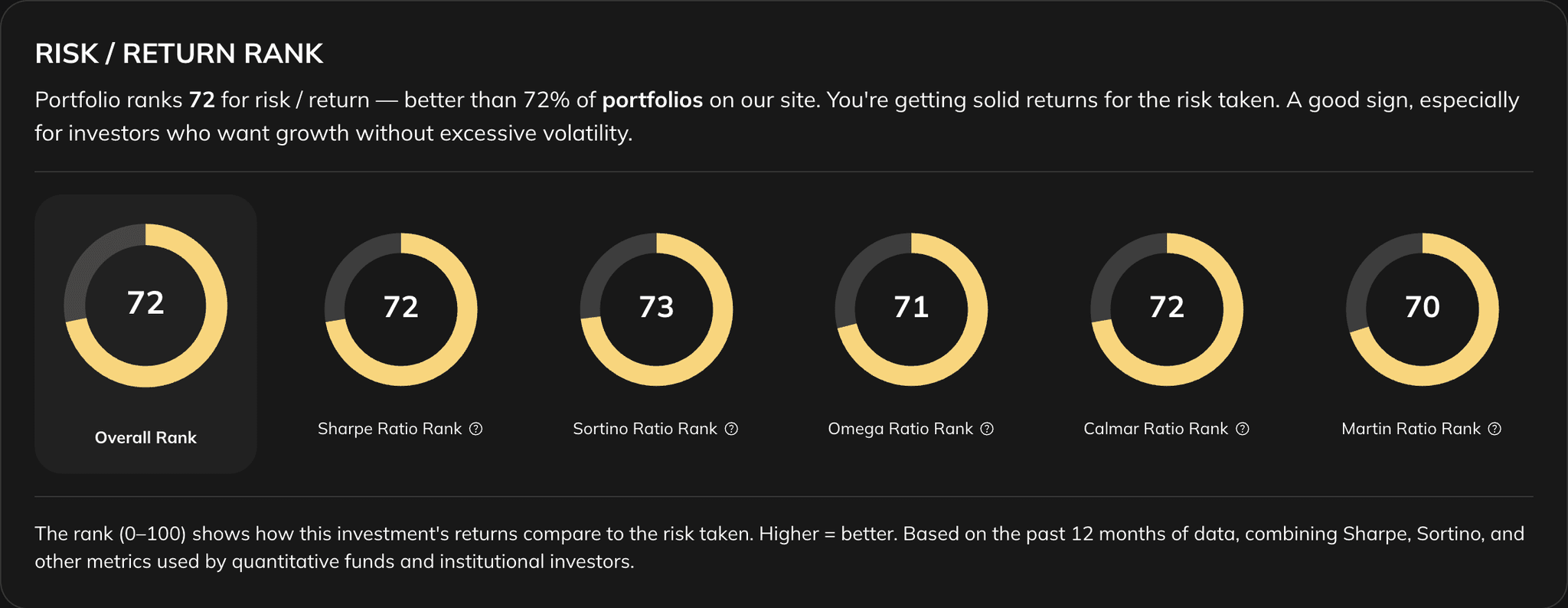
2. Portfolio Risk-Adjusted Rank
The Risk / Return Rank places Calmar alongside four complementary return-for-risk metrics and compares the combined result with a peer group.
3. Risk-Adjusted Returns Table
Compares portfolio and benchmark indicators in one view for multi-metric validation.

Example
If two portfolios deliver similar annualized return, but Portfolio A has smaller maximum drawdown, Portfolio A will usually have a higher Calmar Ratio and stronger downside-adjusted quality.
Best Practices
Use relevant lookback windows
Evaluate short and long windows before conclusions.
Do not rely on Calmar alone
Combine with Sharpe, Sortino, and Omega for fuller context.
Check benchmark relevance
Relative conclusions are weaker with mismatched benchmarks.
Review after allocation changes
Calmar can shift materially after rebalancing decisions.