

Performance Analysis
/Martin Ratio Calculator Guide
Martin Ratio Calculator Guide
Learn how to evaluate excess return relative to downside drawdown stress with the Martin Ratio tool.
The Martin Ratio Calculator divides excess return by Ulcer Index.
Because Ulcer Index captures both drawdown depth and duration, Martin Ratio focuses on downside stress more directly than volatility-based measures.
Martin Ratio rewards return achieved with controlled downside drawdown stress, helping investors evaluate quality beyond headline performance.
How to Use the Tool
Use this workflow in Martin Ratio:
1
Select Portfolio Positions
Choose or build the portfolio you want to evaluate.
2
Choose Benchmark
Set benchmark for comparative context in rank and table outputs.
3
Set Risk-free Rate and Lookback
Define annualized risk-free input and rolling period for analysis.
4
Calculate Martin Ratio
Run the tool to generate rolling annualized Martin Ratio output.
5
Interpret with Drawdown Context
Use chart trend plus ranking/table context to judge stability and quality.
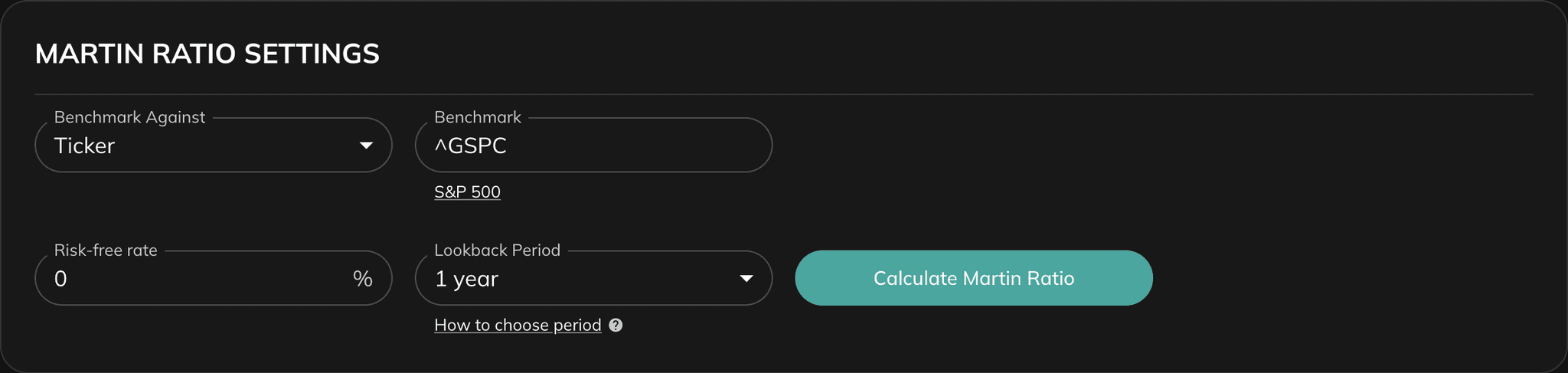
Tool Settings
Benchmark
Comparison context for rank and table outputs.
Risk-free Rate
Annualized baseline used in excess return term.
Lookback Period
Rolling window for Martin Ratio and Ulcer-based denominator.
Results: Section-by-Section Guide
1. Martin Ratio Chart
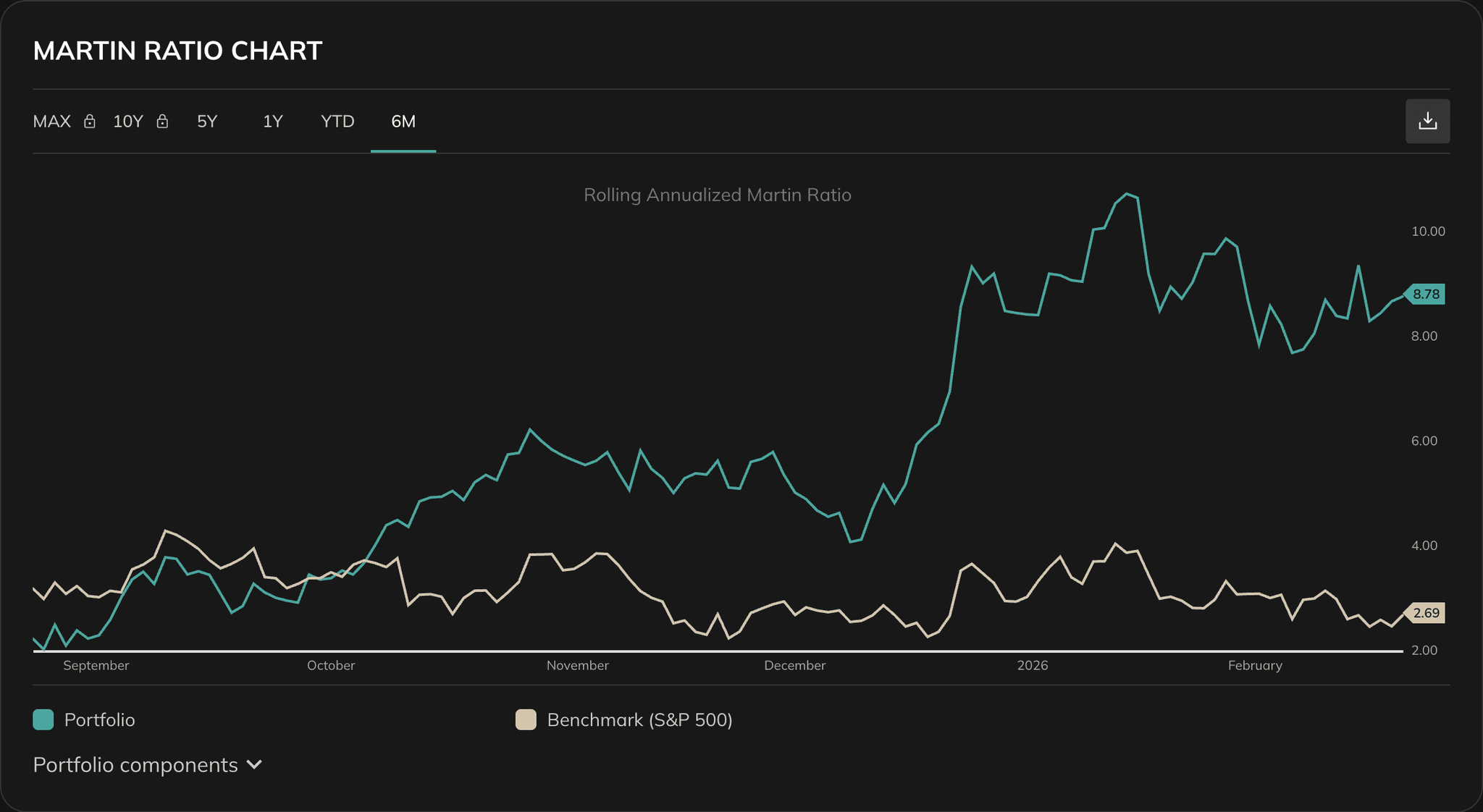
Shows rolling annualized Martin Ratio and highlights changes in downside-adjusted efficiency through time.
General interpretation:
- Higher values suggest stronger return quality with lower downside stress.
- Lower values suggest weaker return quality or elevated downside burden.
- Stability over time often matters as much as peak values.
2. Portfolio Risk-Adjusted Rank
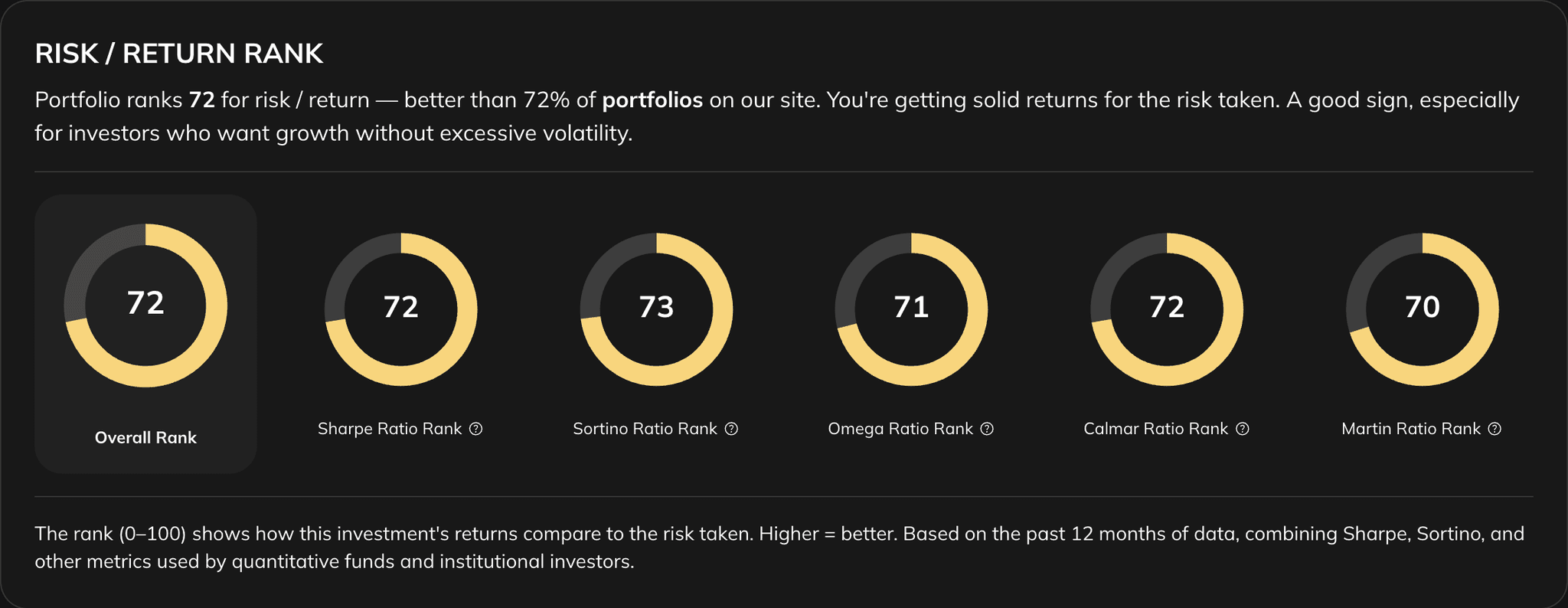
The Risk / Return Rank places Martin alongside four complementary return-for-risk metrics and compares the combined result with a peer group.
3. Risk-Adjusted Returns Table
Cross-check Martin with Sharpe, Sortino, Calmar, Treynor, and related metrics.

4. Interpretation and Strategy Section
The page text emphasizes:
- consistency versus volatility in rolling values
- identifying weak components for risk management
- using results for diversification and tactical portfolio adjustments
- benchmarking portfolio Martin Ratio versus peers
Example
If Portfolio A and B have similar return but A has smaller and shorter drawdowns, A tends to have higher Martin Ratio due to lower Ulcer-based downside denominator.
Best Practices
Use with Ulcer Index context — Martin denominator is drawdown-stress based, so UI interpretation matters.
See also: Ulcer Index, Sharpe Ratio, Sortino Ratio, Treynor Ratio