

Optimization
/Asset Correlations
Asset Correlations
Measure how closely the price movements of different assets in your portfolio are related to each other — and use that to improve diversification.
Asset correlation measures the relationship between the price movements of different assets in your portfolio. Values range from -1 to 1:
- 1 — assets move in the same direction (perfectly positive correlation)
- 0 — assets move independently, with no discernible relationship
- -1 — assets move in opposite directions (perfectly negative correlation)
The correlation matrix is calculated using the Spearman method, which is well-suited for financial data because it assesses the strength and direction of relationships based on ranks rather than assuming a linear relationship.
Asset Correlation Settings
Before running the calculation, configure the settings in the Asset Correlation Settings panel.
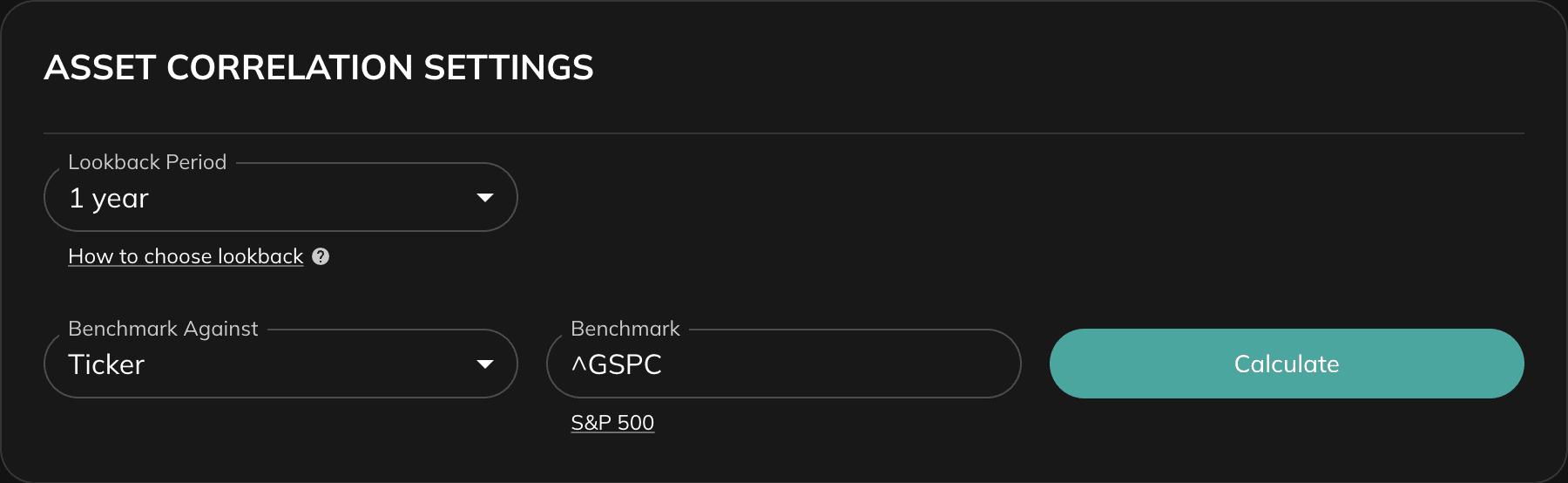
- Lookback Period — The historical time window used to calculate correlations. Options range from 3 months to the maximum available history. A shorter period captures recent dynamics; a longer period provides more stable estimates.
- Benchmark — An optional reference asset (e.g., SPY) added to the matrix alongside your portfolio holdings. Useful for seeing how each asset correlates with the broader market.
Click Calculate to run the analysis.
The Correlation Heatmap
After calculating, the results appear as a color-coded matrix table. Each cell shows the correlation coefficient between the asset in that row and the asset in that column.
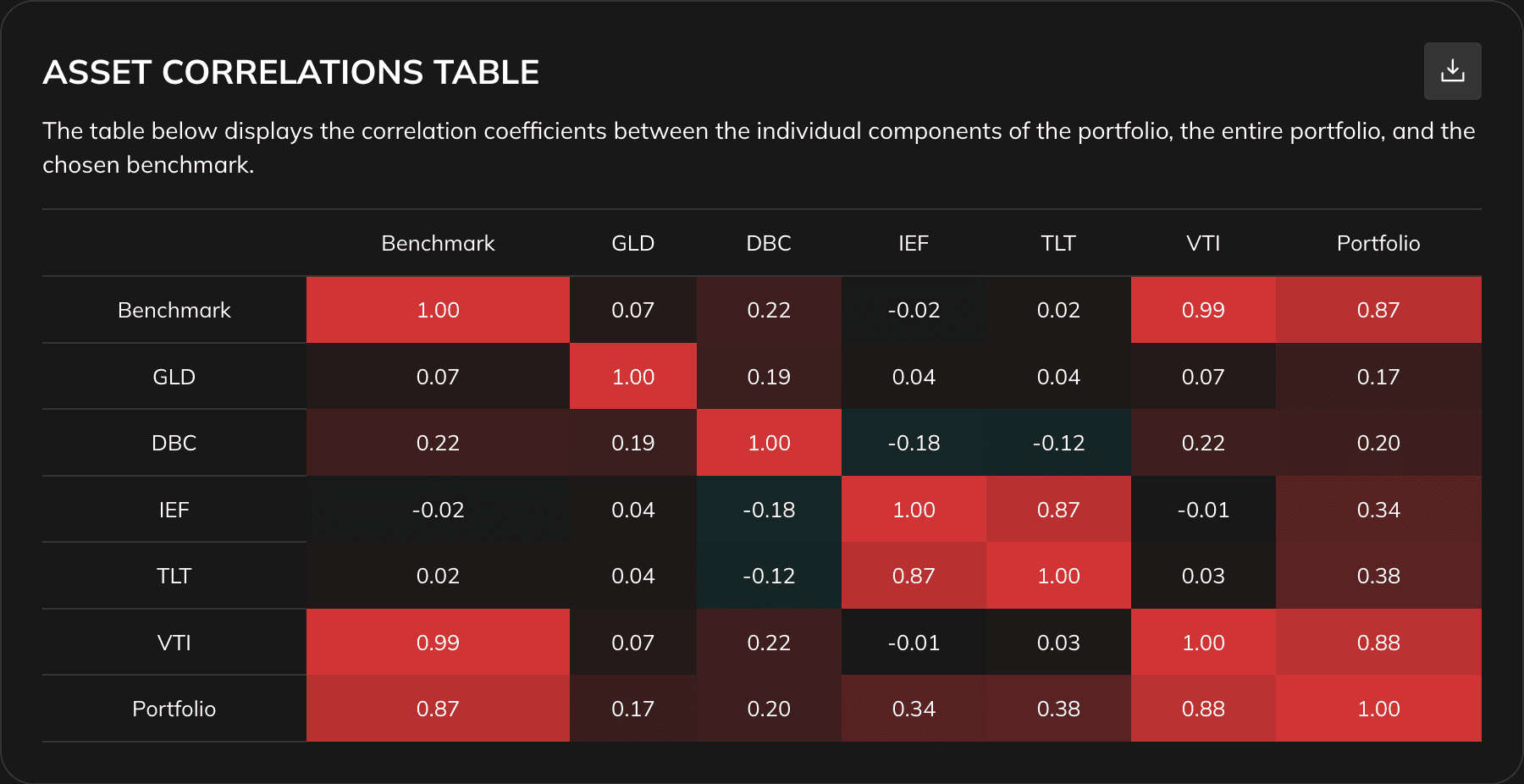
The color scale runs from green (negative correlation) through white (near zero) to red (positive correlation). The diagonal always shows 1.00 because each asset is perfectly correlated with itself.
Interpreting Correlation Values
Strong positive correlation (0.5 to 1)
Assets that tend to move together. When one falls, the other is likely to fall as well. Holding many strongly correlated assets increases the risk of simultaneous losses.
Weak or no correlation (0 to 0.5)
Assets that have limited or no relationship with each other. Including such assets in a portfolio provides diversification benefits and reduces overall volatility.
Negative correlation (-1 to 0)
Assets that tend to move in opposite directions. When one loses value, the other may gain. Negative correlation offers the strongest potential for risk mitigation through diversification.
Correlations Change Over Time
Correlation values are not static. Market conditions — especially during crises — can significantly alter relationships between assets. For example, stocks and bonds that typically have low or negative correlation can both fall simultaneously during severe market stress. Review your portfolio's correlations periodically.
Understanding Lookback Periods
A lookback period is the historical time frame over which data is analyzed to estimate correlations. Choosing the right period is essential for obtaining accurate and actionable correlation estimates that impact portfolio optimization.
Factors to Consider
Short-Term vs. Long-Term Trends
Shorter periods capture recent market dynamics but are more volatile and less statistically stable — useful for tactical adjustments. Longer periods provide more stable estimates but may not reflect recent changes.
Changing Correlations
Market conditions can significantly alter correlations, especially during periods of market turmoil or economic shifts. For example, typical inverse correlations between stocks and bonds can turn positive during crises, affecting diversification benefits.
Overfitting Risk
Using excessively long lookback periods can lead to overfitting, making the model too tailored to historical data and potentially less effective in future scenarios.
Stability vs. Responsiveness
Balancing the need for stable correlation estimates with the ability to respond to recent market changes is crucial. For instance, a 1-year lookback might be overly responsive, while a 10-year lookback might be too sluggish.
Practical Recommendations
Moderate Durations
A moderate lookback period (e.g., 3 to 5 years) is often recommended as it balances stability and responsiveness. It captures sufficient historical data to provide robust estimates while remaining sensitive to recent trends.
Adaptive Approaches
Some portfolio managers use adaptive methods that adjust the lookback period based on market conditions. Shorter lookbacks might be used during volatile periods, while longer lookbacks are preferred in stable markets.
Factor Portfolios
For factor portfolios, a one-year lookback period can be effective in identifying low-correlation factors, as evidenced in studies focusing on factor investing strategies.
Cross-Asset Correlations
For multi-asset portfolios, a 3-month lookback period might be employed to quickly adapt to changing correlations between asset classes like equities and commodities during market turmoil.
Using Correlation to Improve Your Portfolio
Follow these steps to apply correlation data to your investment decisions:
Identify high-correlation clusters
Look for groups of assets with correlation values above 0.7–0.8. These assets behave similarly and add limited diversification value on top of each other.
Find diversifying assets
Identify assets with low or negative correlation to your existing holdings. Adding them can reduce overall portfolio volatility without necessarily sacrificing expected return.
Consider asset classes beyond equities
Bonds, commodities, real estate investment trusts (REITs), and cash equivalents often have lower correlations with stocks — especially during normal market conditions.
Rebalance as correlations shift
Correlations change as market regimes change. Re-run the tool periodically and adjust holdings to maintain your desired diversification level.
How to Diversify Your Portfolio
To achieve a well-diversified portfolio, consider including assets across several dimensions:
Different asset classes
A mix of stocks, bonds, cash, and alternative investments often shows lower cross-asset correlations, especially during moderate market conditions.
Geographic diversification
Investing in assets from different countries or regions can reduce concentration risk, as economic cycles and market trends vary across geographies.
Sector diversification
Stocks from different industries react differently to economic events. Spreading holdings across sectors reduces the impact of sector-specific downturns.
Investment styles
Combining value, growth, and income-oriented investments can add balance, as different styles tend to outperform in different market conditions.
Suggested Next Steps
Run correlations on your current portfolio
Start by analyzing what you already hold. Look for unexpected clusters of high correlation that may indicate hidden concentration risk.
Experiment with the lookback period
Compare results across different periods (e.g., 1Y vs 5Y) to see how relationships have changed over time.
Use the benchmark to gauge market sensitivity
Adding a market index like SPY as a benchmark shows how each asset correlates with the overall market — useful context for evaluating diversification.
Combine with Portfolio Optimization
After identifying correlations, use the Portfolio Optimizer to find the allocation that best balances risk and return given those relationships.