

Risk And Return
/Sharpe Ratio Explained
Sharpe Ratio Explained
Learn what the Sharpe Ratio measures, how to interpret it, and why it is the most widely used metric for comparing risk-adjusted performance.
The Sharpe Ratio measures how much excess return a portfolio generates for each unit of volatility it takes on. It is the single most widely used risk-adjusted performance metric in finance.
The core idea is simple: earning 15% return is not impressive if you took enormous risk to get there. Earning 10% with half the volatility may be a far better outcome. The Sharpe Ratio quantifies this distinction — it tells you how efficiently a portfolio converts risk into return.
Raw return tells you what you earned. The Sharpe Ratio tells you whether you were adequately compensated for the risk you took. It is the essential metric for comparing any two investments, strategies, or portfolios on an equal footing.
The Sharpe Ratio Formula
The Sharpe Ratio is the portfolio's excess return — its return above the risk-free rate — divided by the standard deviation of that excess return. The numerator captures what the portfolio earned beyond a zero-risk alternative; the denominator captures how much that return fluctuated.
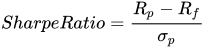
Where:

Return of portfolio

Risk-free rate

Standard deviation of portfolio excess returns
The formula is usually applied to annualized values, so the result is comparable across portfolios and time horizons regardless of the underlying return frequency.
What the Sharpe Ratio Tells You
The Sharpe Ratio provides a single number that captures the quality of a portfolio's returns relative to the risk taken. Consider two portfolios:
Portfolio A: 12% Return, 20% Volatility. Assuming a 2% risk-free rate: Sharpe = (12% − 2%) / 20% = 0.50. For every 1% of volatility, the portfolio generated 0.50% of excess return.
Portfolio B: 8% Return, 8% Volatility. Assuming a 2% risk-free rate: Sharpe = (8% − 2%) / 8% = 0.75. For every 1% of volatility, the portfolio generated 0.75% of excess return.
Portfolio A has higher raw return. But Portfolio B has a higher Sharpe Ratio — it is more efficient at converting risk into return. An investor who can use leverage could theoretically scale Portfolio B up to match Portfolio A's return while still taking less risk.
This is the fundamental insight: the Sharpe Ratio separates return quality from return quantity.
How to Interpret Sharpe Ratio Values
There is no universal Sharpe threshold that works across all assets, strategies, and market regimes — a value that looks strong for a single stock can be ordinary for a diversified portfolio, and vice versa. The right reference points depend on what you are measuring and over what horizon.
As a short guideline, a negative Sharpe Ratio means the portfolio did not compensate you for the risk taken, values around the market are typical, and sustained values well above the market are uncommon and worth scrutinizing for short track records, illiquid pricing, or survivorship bias.
For an up-to-date interpretation, use the Sharpe Ratio Calculator. It shows the live Sharpe Ratio of the S&P 500 and Nasdaq-100 alongside median, 75th-, and 99th-percentile values for portfolios, stocks, and ETFs tracked on PortfoliosLab — so you can compare your result against meaningful, current benchmarks rather than a fixed rule of thumb.
Why Time Periods and Ranks Matter
A Sharpe Ratio is always tied to the period used to calculate it. PortfoliosLab reports fixed-period values so you can distinguish recent performance from a record that persisted across different market conditions:
1-Year Sharpe Ratio
Shows recent risk-adjusted performance. It reacts quickly to changing conditions, but one favorable or difficult market regime can dominate the result.
5-Year Sharpe Ratio
Tests whether the recent result held up over a longer period. It is often a useful starting point when comparing established stocks and funds.
10-Year Sharpe Ratio
Covers more market cycles and provides stronger evidence of persistence, but it can hide a meaningful improvement or deterioration in recent years.
All-Time Sharpe Ratio
Uses the full available history. It adds long-term context, but comparisons are less direct when investments have different inception dates.
The relationship between periods is often more informative than the highest value. Strong 1-year results with weak 5- or 10-year results may reflect a recent improvement or simply a favorable environment. Strong results across several periods provide better evidence that the risk-adjusted record was persistent.
Sharpe rank adds peer context. A rank of 80 means the investment has a higher Sharpe Ratio than approximately 80% of its comparison universe over the same period. Stocks are ranked against stocks, ETFs against ETFs, mutual funds against mutual funds, and portfolios against qualifying portfolios. The same rank across two different universes does not imply the same raw Sharpe Ratio.
You can use 1-, 5-, and 10-year Sharpe fields to sort and filter stocks, ETFs, mutual funds, and portfolios. A practical workflow is to shortlist investments with a strong 5-year record, then inspect the 1-year value for recent improvement or deterioration. Treat a high rank as a research starting point, not a buy signal.
The Role of the Risk-Free Rate
The risk-free rate is not just a technical detail — it materially affects the Sharpe Ratio and its interpretation:
When Rates Are Low (0–2%)
Nearly all of the portfolio's return counts as excess return. Sharpe Ratios tend to appear higher across the board. This was the environment from roughly 2009 through 2021.
When Rates Are High (4–5%+)
A larger portion of return is consumed by the risk-free rate subtraction, leaving less excess return. Sharpe Ratios appear lower even if portfolio quality has not changed. This was the case in the early 1980s and again throughout the post-pandemic tightening cycle.
Choosing a Rate Source
The Sharpe Ratio Calculator in PortfoliosLab supports two options: US Money Market Yield (^CASHX), which tracks the changing short-rate environment over time, and a custom fixed annual rate for standardized comparisons.
When comparing Sharpe Ratios across different time periods, always account for the prevailing risk-free rate. A Sharpe of 0.8 in a 5% rate environment may represent better portfolio management than a Sharpe of 1.0 in a 0% rate environment.
How PortfoliosLab Calculates Sharpe Ratio
PortfoliosLab calculates Sharpe from returns that account for splits and dividends. Returns are compounded into an annualized return, while periodic standard deviation is annualized based on the detected data frequency. Portfolio calculations also reflect the selected allocation and rebalancing settings.
The Sharpe Ratio Calculator guide explains the available rolling windows and risk-free-rate settings. You can use either a fixed annual rate or the historical US Money Market Yield (^CASHX), which changes through time.
Calculation methods vary across data providers. Differences in return frequency, annualization, risk-free rate, or price history can produce different Sharpe values for the same investment.
When to Be Cautious
Sharpe is most useful as a comparison tool, not as proof that an investment is safe or likely to outperform:
A Short Period Can Flatter the Result
A strong 1-year Sharpe may reflect one favorable market regime. Compare it with 5-year, 10-year, and rolling values before treating it as a persistent record.
Smooth Returns Can Hide a Large Eventual Loss
Option-selling, leveraged, and credit strategies can produce steady gains before an infrequent severe loss. Review maximum drawdown and worst periods rather than relying on volatility alone.
Illiquid Pricing Can Suppress Volatility
Infrequent trading or stale valuations can make returns appear smoother than the underlying risk, producing an artificially high Sharpe Ratio.
Different Inputs Produce Different Values
Compare Sharpe values only when the time period, risk-free rate, return frequency, and calculation methodology are compatible.
Backtested Sharpe May Not Survive Real-World Costs
Trading costs, financing, taxes, strategy changes, and selection bias can make realized performance weaker than the historical result.
How to Improve Your Portfolio's Sharpe Ratio
Portfolio Sharpe can improve by reducing unnecessary concentration, combining holdings that behave differently, or changing allocations so that volatility falls without sacrificing proportional return. The stock, ETF, and mutual fund screeners can help you find investments with strong 5- and 10-year risk-adjusted records.
A high-Sharpe fund does not automatically improve a portfolio. Its correlation with your current holdings and the allocation you give it determine the effect on the combined portfolio. Add promising candidates to your portfolio, then use the Portfolio Optimizer to compare the proposed allocation with the original on Sharpe, return, volatility, and drawdown.
Sharpe Ratio vs Other Risk-Adjusted Metrics
The Sharpe Ratio is one of several risk-adjusted metrics. Each uses a different definition of "risk" and captures different aspects of portfolio behavior:
Sharpe vs Sortino
The Sortino Ratio replaces total volatility with downside deviation — penalizing only negative returns. It is more appropriate when you care specifically about losses, not total variability. See Sortino vs Sharpe for a detailed comparison.
Sharpe vs Treynor
The Treynor Ratio replaces total volatility with Beta — measuring return per unit of systematic (market) risk only. It is useful when evaluating how efficiently a portfolio uses its market exposure, but ignores idiosyncratic risk.
Sharpe vs Calmar
The Calmar Ratio replaces volatility with Maximum Drawdown. It directly measures return earned per unit of worst-case loss. More intuitive for investors who think in terms of "how much can I lose" rather than "how much do returns fluctuate."
Sharpe vs Omega
The Omega Ratio considers the entire return distribution above and below a threshold — capturing skewness, kurtosis, and tail behavior that the Sharpe Ratio ignores. It is more comprehensive but less intuitive.
Which Metric to Use?
Start with the Sharpe Ratio for general-purpose comparison. Add the Sortino Ratio if downside risk matters more than total variability. Add the Calmar Ratio if drawdown tolerance is your primary concern. Use all three together for a complete view of risk-adjusted quality.
Best Practices
Compare Like with Like
Use the same period and risk-free-rate assumptions, and compare investments within a relevant peer universe.
Look for Persistence
Review 1-year, 5-year, 10-year, and rolling results. Consistency across periods is more informative than one exceptional reading.
Check the Downside
Pair Sharpe with Sortino Ratio, Calmar Ratio, or maximum drawdown before making a decision.
Test Portfolio Fit
An investment with a strong standalone Sharpe may still duplicate your current exposure. Evaluate its effect on the combined portfolio before changing the allocation.
On this page
- The Sharpe Ratio Formula
- What the Sharpe Ratio Tells You
- How to Interpret Sharpe Ratio Values
- Why Time Periods and Ranks Matter
- The Role of the Risk-Free Rate
- How PortfoliosLab Calculates Sharpe Ratio
- When to Be Cautious
- How to Improve Your Portfolio's Sharpe Ratio
- Sharpe Ratio vs Other Risk-Adjusted Metrics
- Best Practices