

Risk Analysis
/Ulcer Index
Ulcer Index
Learn how to measure downside stress depth and duration with the Ulcer Index tool.
The Ulcer Index (UI) is a downside-risk metric designed to measure both drawdown magnitude and drawdown duration. It was developed by Peter Martin and Byron McCann and focuses on investor "pain" from sustained losses rather than total volatility alone.
Unlike metrics that treat upside and downside moves symmetrically, Ulcer Index penalizes downside pressure more heavily. This makes it useful for evaluating how stressful an investment can feel in real-world holding conditions.
This tool helps you:
- quantify downside stress in a rolling framework
- compare portfolio downside behavior against a benchmark
- monitor changes in risk profile across market regimes
Two portfolios can have similar returns but very different downside experience. Ulcer Index highlights which one is easier to hold during prolonged declines.
How to Use the Tool
Use this workflow in Ulcer Index:
1
Select Portfolio Positions
Choose or build the portfolio in the portfolio selector.
2
Set Lookback Period
Choose rolling window length (1M to 10Y) based on your investment horizon.
3
Choose Benchmark
Select a relevant benchmark to compare downside behavior in context.
4
Run Calculation
Click "Calculate Ulcer Index" to generate the rolling chart.
5
Interpret Risk Dynamics
Analyze trend direction, high-risk episodes, and benchmark-relative downside behavior.
Practical Tip
Re-check Ulcer Index after major allocation changes or market shocks to confirm downside risk is still aligned with your tolerance.
Tool Settings
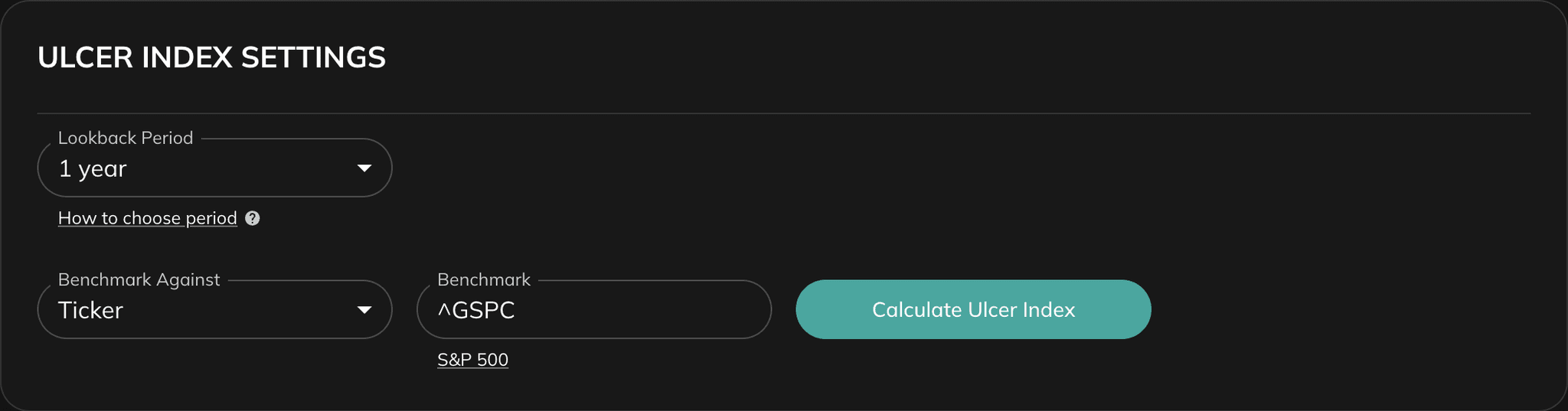
The Ulcer Index tool uses two key settings:
- Lookback Period — Defines rolling-window length for downside-risk estimation.
- Benchmark — Adds reference context so you can compare your portfolio downside behavior to a relevant market baseline.
How to choose lookback period:
- Short-term traders: often prefer short windows (for example, around 1 month / 21 trading days) for faster reaction to recent downside changes.
- Medium-term investors: often use 3-6 month windows to balance responsiveness and noise reduction.
- Long-term investors: often use 1 year or longer for smoother structural downside trends.
Shorter windows are more sensitive to recent price changes; longer windows are more stable and less reactive.
If required inputs are missing (for example, invalid positions or no benchmark), calculation is blocked until validation issues are fixed.
Results: Section-by-Section Guide
Rolling Ulcer Index Chart
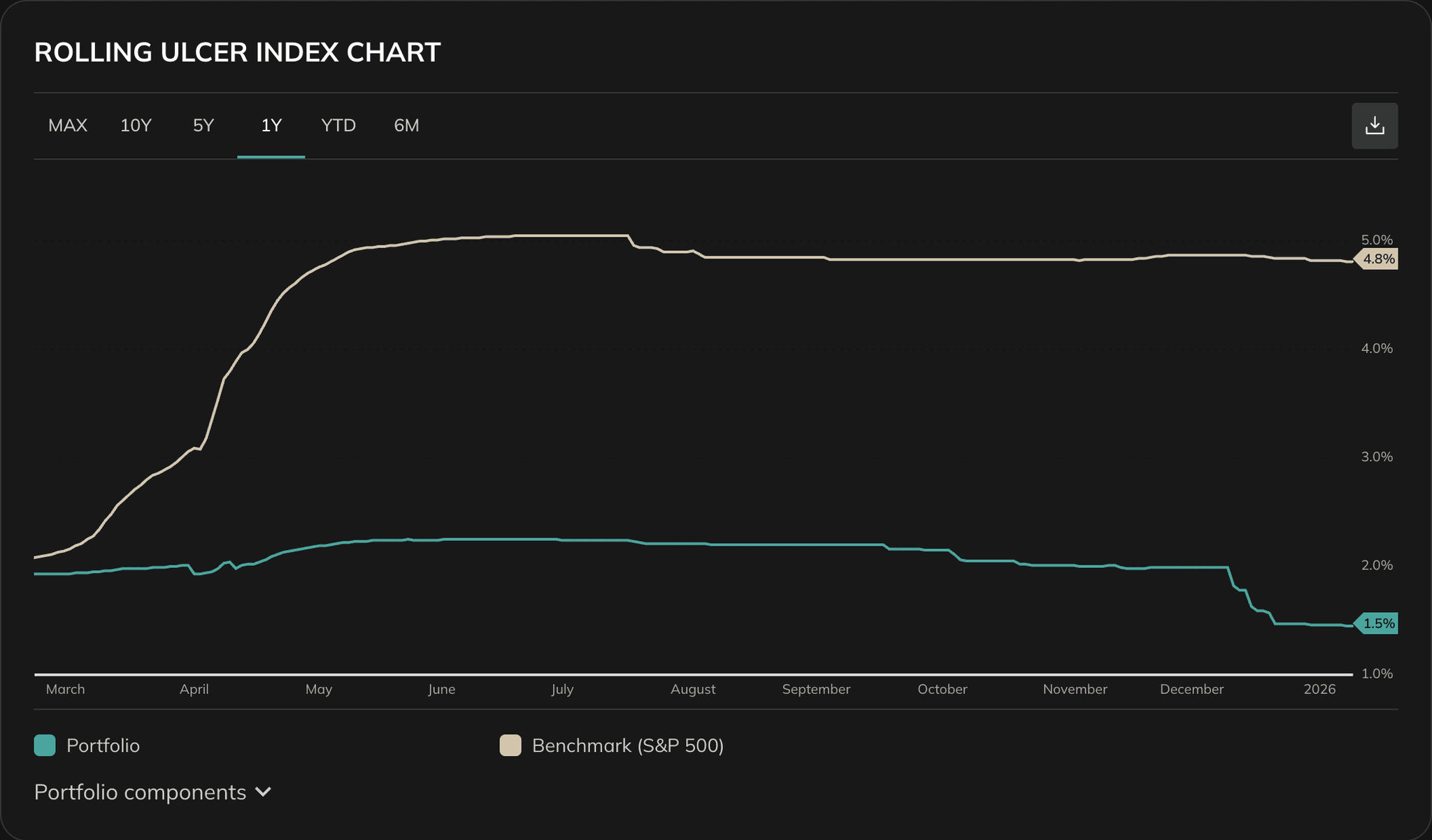
This is the main output section. It shows how downside stress changes over time.
How to interpret values:
- Lower UI values: relatively smaller drawdowns and milder downside pressure.
- Higher UI values: deeper and/or longer drawdowns, indicating higher downside risk.
How to interpret the rolling chart:
- Identify trend direction: rising UI can signal increasing downside stress; falling UI can indicate risk normalization.
- Find high-risk and low-risk regimes: use peaks and troughs to identify periods of elevated or reduced downside pressure.
- Compare with benchmark: benchmark context helps determine whether portfolio downside risk is better or worse than market reference.
- Monitor changes regularly: persistent UI shifts may require portfolio-risk adjustments.
Interpretation Framework
Ulcer Index is a relative metric. Use it to compare securities, portfolios, and market regimes rather than relying on one isolated reading.
Example
Suppose two portfolios are evaluated over the same lookback period:
Portfolio A shows a lower rolling Ulcer Index most of the time, with shorter and shallower downside episodes. Portfolio B shows repeated high UI spikes, reflecting deeper and longer drawdown stress.
Even if long-term return is similar, Portfolio A may be easier to hold and more aligned with conservative risk tolerance because downside stress is lower and more stable.
Best Practices
Use Ulcer Index with benchmark context
Relative comparison improves interpretation quality.
Match lookback to strategy horizon
Short windows for tactical monitoring, long windows for structural risk assessment.
Track rolling behavior continuously
Risk regime shifts are often more informative than one-time values.
Combine with complementary risk tools
Use Drawdowns, Value at Risk, and Expected Shortfall for a fuller downside-risk picture.
See also: Drawdown Analysis, Value at Risk, Expected Shortfall