

Optimization
/Risk Parity Optimization
Risk Parity Optimization
Allocate your portfolio so each asset contributes equally to total risk — rather than concentrating capital in a few dominant positions.
Risk Parity portfolio optimization is an investment strategy that seeks to distribute risk — not capital — equally across all assets in a portfolio. Instead of allocating based on expected returns or market capitalization, it uses a mathematical model to determine how much of each asset is needed so that every position contributes the same amount to the portfolio's overall risk.
This approach considers each asset's volatility, correlation, and covariance with other assets to calculate the equal-risk allocation. The result is a portfolio that is not overly exposed to any single asset and maintains a consistent risk profile across all positions.
True diversification
Risk is spread across all assets, not concentrated in high-volatility positions that may dominate a traditional market-cap or equal-weight portfolio.
Resilience in various market conditions
More evenly distributed risk leads to portfolios that tend to hold up better across different market environments, including downturns.
Reduced volatility
Focusing on risk allocation rather than return-chasing typically produces lower overall portfolio volatility and more consistent returns over time.
Predictable risk profiles
The risk contribution of each asset is explicitly controlled, making the portfolio easier to manage and rebalance.
Optimization Settings
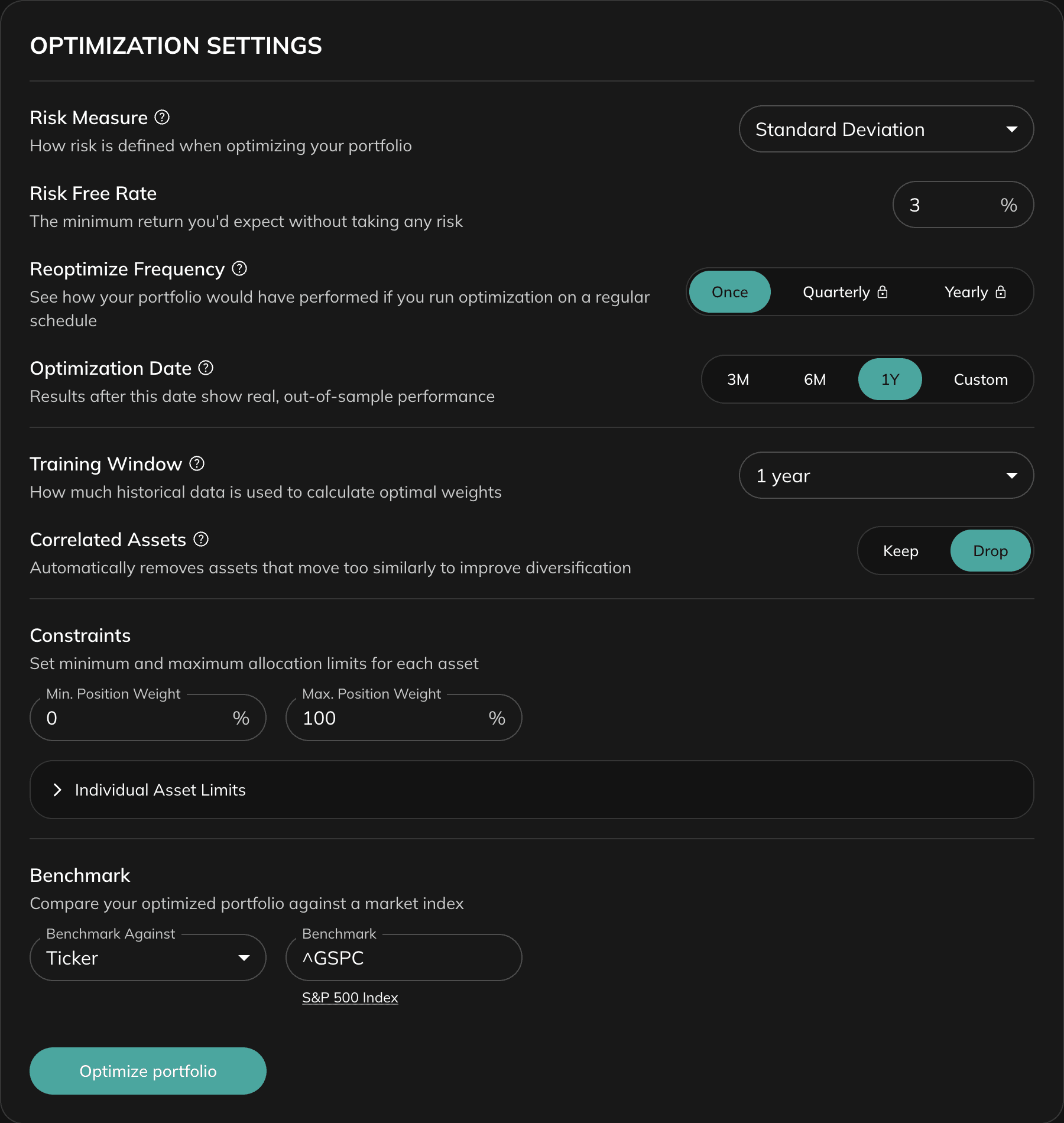
Risk Measure
Defines how risk is defined when calculating equal risk contributions. The optimizer adjusts weights until each asset contributes equally according to the selected measure.
Volatility-Based:
Standard Deviation
The default and most widely used measure. Captures how much returns deviate from their average. Each asset is weighted so its contribution to portfolio standard deviation is equal to all others.
Mean Absolute Deviation (Pro)
The average absolute deviation of returns from the mean. Less sensitive to extreme outliers than standard deviation. Useful when return distributions have heavy tails.
Downside Risk:
Semi Standard Deviation (Pro)
Only measures negative deviations from the mean — downside moves. Focuses on protecting against losses rather than penalizing upside volatility.
Sortino Ratio (Pro)
Weights assets to equalize contributions to downside-adjusted return. Assets that produce high returns relative to their downside risk receive larger allocations.
Omega Ratio (Pro)
Considers the full distribution of returns, comparing probability-weighted gains to probability-weighted losses relative to a threshold. Robust to non-normal return distributions.
Drawdown-Based:
Conditional Drawdown at Risk (CDaR) (Pro)
The average drawdown in the worst scenarios beyond a given probability threshold. More nuanced than maximum drawdown — accounts for how often severe declines occur, not just how deep they go.
Ulcer Index (Pro)
Measures both the depth and duration of drawdowns. An asset that stays in drawdown for a long period scores higher, even if the maximum loss is moderate. Good for investors sensitive to prolonged losses.
Tail Risk:
Conditional Value at Risk (CVaR) (Pro)
Also known as Expected Shortfall. The average loss in the worst scenarios beyond the VaR threshold. The most conservative tail risk measure — focuses on reducing the impact of extreme events.
Which Risk Measure to Choose
Start with Standard Deviation for a balanced result. Switch to Maximum Drawdown or CVaR if you are primarily concerned with protecting against severe losses. Use Sortino or Omega Ratio if you want to focus on downside risk while preserving upside potential.
Risk Free Rate
The minimum return expected without taking any risk — typically approximated by short-term government bond yields. Used in risk-adjusted metric calculations for the results comparison.
Reoptimize Frequency
Once
Calculates risk-equal weights using all available data up to the Optimization Date. A single set of weights is produced.
Quarterly (Pro)
Re-calculates weights at the end of each quarter using only data available up to that point, then evaluates performance on the next quarter. Simulates live deployment without look-ahead bias.
Yearly (Pro)
Re-calculates annually. Lower turnover than quarterly — suitable for long-term strategies.
Optimization Date
Splits history into a training period (before the date) and an out-of-sample test period (after the date). Performance after the date reflects real, unseen behavior — not the data used to compute the weights.
Use this to backtest the strategy historically. Preset options: 1Y, 2Y, 3Y, 5Y ago, or a custom date.
Training Window
How much historical data is used to estimate risk contributions.
- 1 Year — reactive to recent conditions, less statistically stable
- 3 Years — balanced default for most investors
- 5+ Years — stable estimates, may lag on recent market regime changes
Correlated Assets
When set to Drop, assets with correlation above 0.95 are automatically removed before optimization. The optimizer keeps the less-correlated of each pair. This prevents nearly identical assets from artificially inflating their combined weight.
Constraints
Min. Position Weight
Minimum allocation any asset can receive. Default is 0%.
Max. Position Weight
Maximum allocation any asset can receive. Default is 100%.
Individual Asset Limits
Per-symbol overrides for specific tickers. Expand to see the full table.
Freeze
Lock an asset's current allocation. The optimizer will not adjust that position.
Benchmark
An optional reference index added to charts for performance comparison.
Results
Optimal Asset Allocation
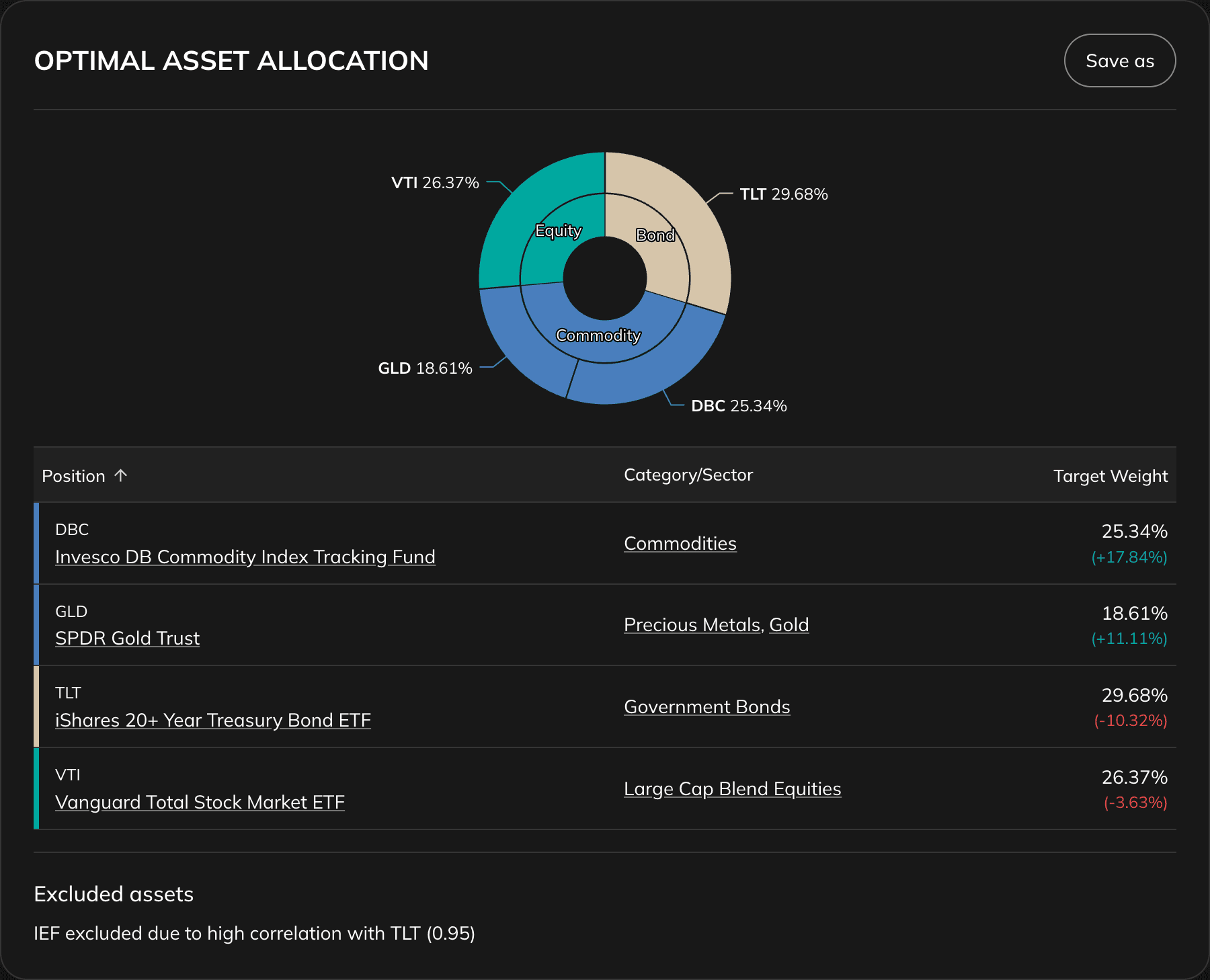
The recommended weights are calculated so each asset contributes equally to portfolio risk. In practice, lower-volatility assets typically receive higher weights, and higher-volatility assets receive lower weights — which is the defining characteristic of risk parity versus equal or cap-weight portfolios.
A Save as Portfolio button lets you save the optimized allocation directly.
Key Improvements
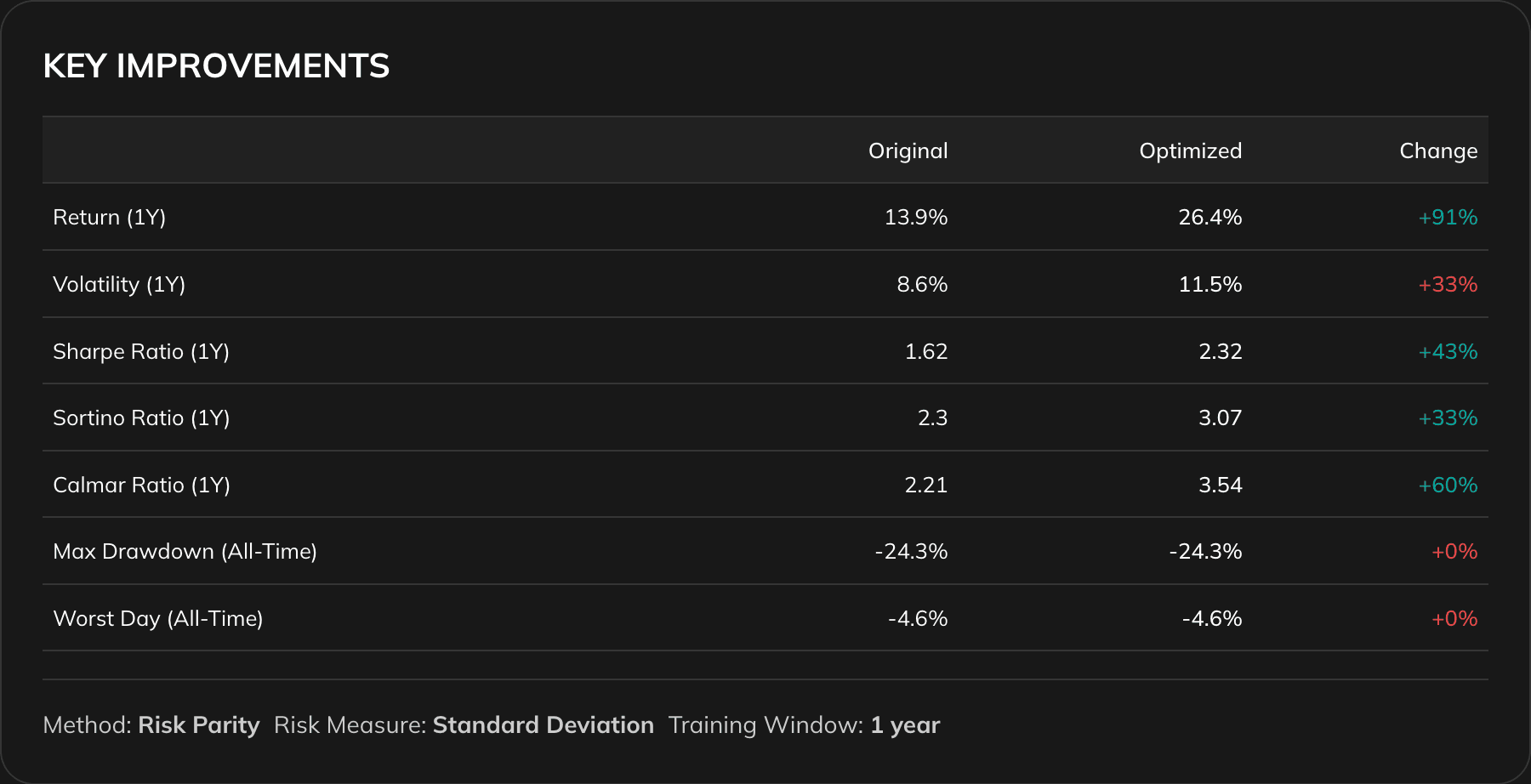
Side-by-side comparison across key metrics: Return (1Y), Volatility (1Y), Sharpe Ratio (1Y), Sortino Ratio (1Y), Calmar Ratio, Max Drawdown, and Worst Day. Green indicates improvement; red indicates regression.
Performance and Risk Charts
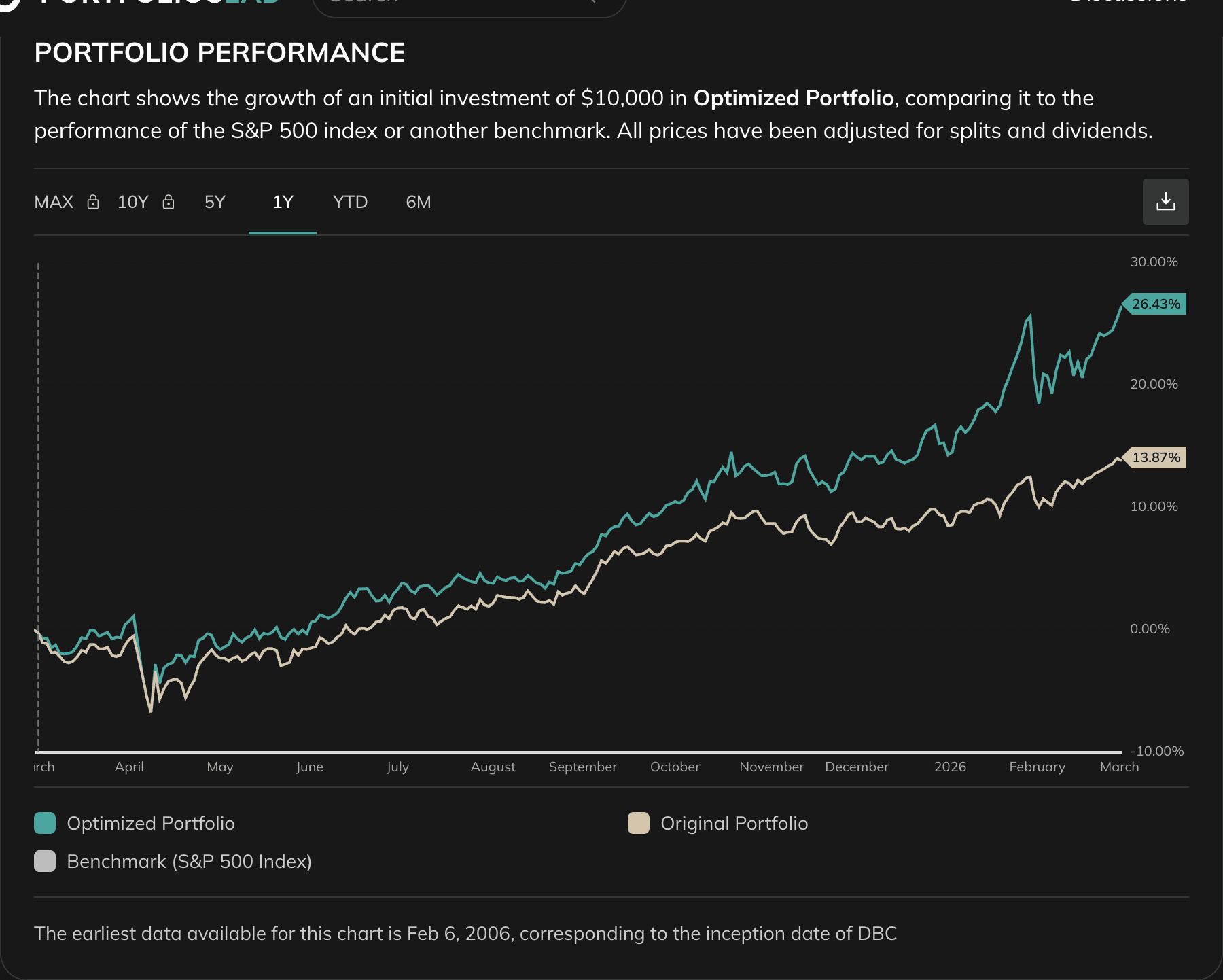
Full historical charts: Portfolio Performance, Allocation Over Time, Sharpe Ratio, Drawdowns, Volatility, and Correlation Matrix.
Risk Parity vs Other Approaches
vs Equal Weight
Equal weight gives each asset the same capital regardless of its risk. Risk Parity gives lower-volatility assets more capital so their risk contribution matches that of higher-volatility assets.
vs Mean-Variance Optimization
MVO maximizes return for a given risk level but requires accurate expected return estimates, which are difficult to forecast. Risk Parity avoids this by using only the covariance structure.
vs HRP and HERC
HRP and HERC also use risk-based weighting but apply hierarchical clustering to group assets first. Risk Parity applies equal risk contribution directly across individual assets without grouping.
Leverage in Risk Parity
To achieve equal risk contribution from low-volatility assets like bonds, classic risk parity strategies often use leverage. The tool calculates the optimal un-leveraged allocation, but the principle applies — low-risk assets will receive the largest weights.
Suggested Next Steps
Compare with equal-weight allocation
Set all assets to equal weight and run Portfolio Analysis to compare how risk parity changes volatility, drawdowns, and Sharpe ratio versus a simple equal-weight baseline.
Try different risk measures
Run Risk Parity with Standard Deviation and then again with CDaR or CVaR to see how tail-risk-focused allocation differs from volatility-focused allocation.
Combine with Asset Correlations
Use the Asset Correlations tool first to understand how your assets interact. Risk Parity uses this information implicitly — seeing it explicitly helps you make better decisions about which assets to include.