

Risk Analysis
/Expected Shortfall
Expected Shortfall
Learn how to estimate average loss severity beyond VaR with the Expected Shortfall (ES) tool.
Expected Shortfall (ES) estimates the average loss when losses are already worse than the Value at Risk threshold.
While VaR answers "what loss threshold might be breached with a small probability?", ES answers "if that bad tail event happens, how large is the average loss?"
This tool helps you:
- evaluate tail-loss severity in dollar terms
- compare downside severity across portfolios
- track how extreme-risk profile changes through time
VaR gives a threshold, but ES describes how painful losses can be beyond that threshold. This makes ES especially useful for stress-aware risk management.
How to Use the Tool
Use this workflow in Expected Shortfall:
1
Select Portfolio Positions
Build or choose the portfolio in the portfolio selector before running the calculation.
2
Choose ES Method
Select Historical ES or Gaussian ES depending on whether you prefer empirical or distribution-based tail estimation.
3
Set Significance Level
Enter significance level (for example, 5% or 1%). Lower levels focus on more extreme tail events.
4
Set Current Portfolio Value
Provide the current portfolio value to express ES in absolute dollar loss terms.
5
Calculate and Review the Rolling Chart
Click "Calculate ES" and interpret how tail-loss severity evolves over time.

Practical Tip
Use ES together with VaR for the same portfolio and significance level: VaR for threshold, ES for average severity beyond that threshold.
Tool Settings
The ES tool has three core settings:
Method
Historical ES uses observed return tails; Gaussian ES estimates tail severity under normal-distribution assumptions.
Significance Level
Sets the tail probability used for ES estimation (for example, 5% or 1%).
Current Portfolio Value
Converts the ES estimate into an absolute dollar loss figure.
Method guidance:
- Historical ES: often better reflects observed market tail behavior.
- Gaussian ES: useful baseline model, but may understate risk in fat-tail regimes.
If required inputs are missing (for example, invalid positions), calculation is blocked until validation issues are resolved.
Results: Section-by-Section Guide
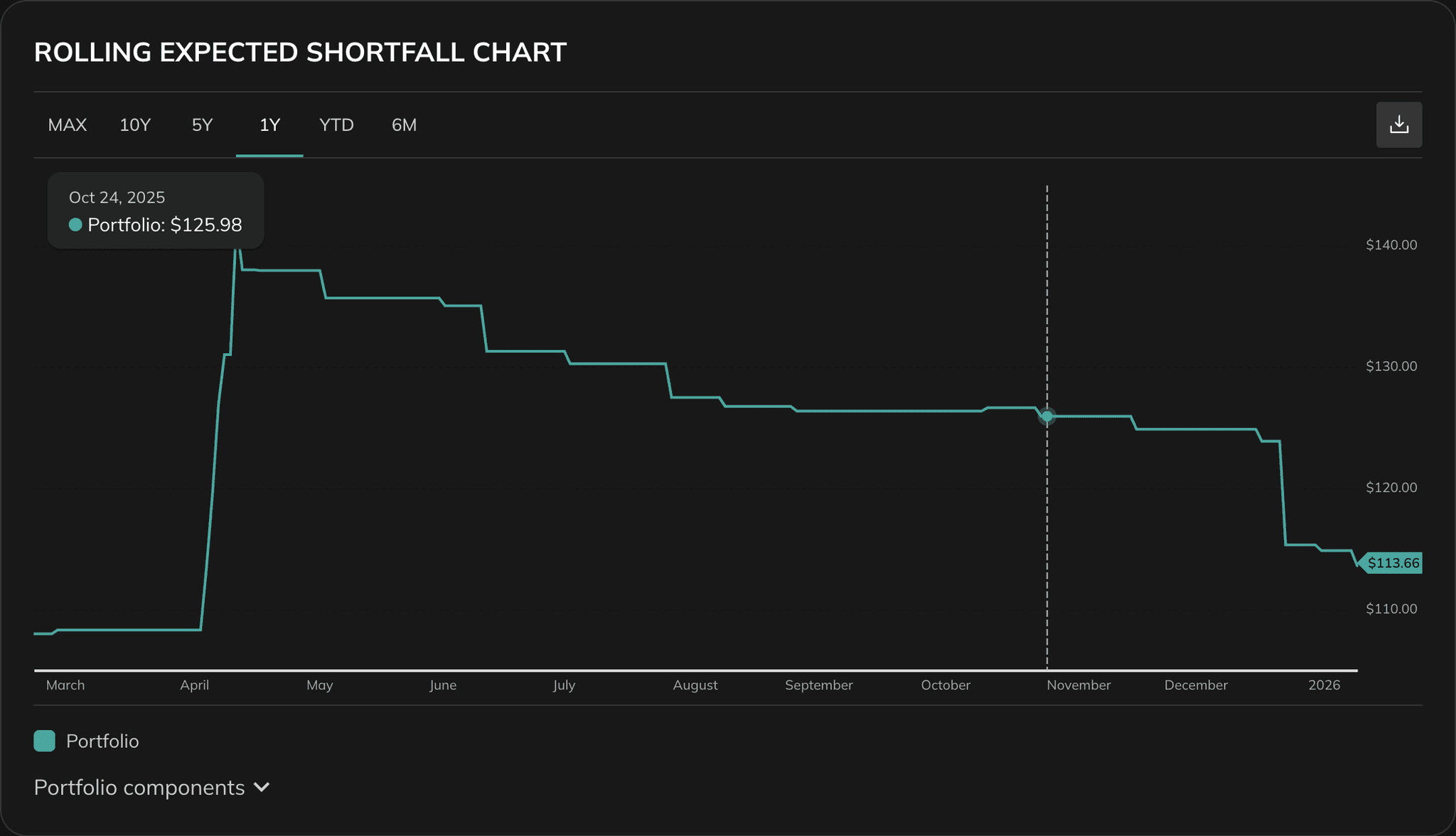
Rolling Expected Shortfall Chart
This is the primary output section. It shows how estimated average tail loss changes over time.
Use it to identify:
- periods when tail-risk severity rises sharply
- whether downside extremes are stable or regime-dependent
- how method and significance-level choices affect estimated severity
Interpretation Framework
ES is conditional tail severity. It estimates average loss in the worst probability slice, not the typical daily loss.
Example
Suppose you calculate Expected Shortfall at a 1% significance level and get $44,334.
Interpretation:
- There is a 1% tail region where losses are worse than VaR.
- Inside that extreme-loss region, the average expected loss is about $44,334.
This is exactly why ES complements VaR:
- VaR tells where the threshold starts.
- ES tells how severe losses are beyond that threshold.
Best Practices
Use ES together with VaR
Treat VaR as threshold and ES as tail-loss severity for a fuller risk picture.
Compare Historical and Gaussian ES
Method gaps can reveal model risk and non-normal tail behavior.
Test multiple significance levels
Evaluate both moderate and extreme tails (for example, 5% and 1%).
Monitor rolling ES through market regimes
Tail risk can change quickly during stress periods; re-check regularly.