New: Diversifier Pages for ETFs and Mutual Funds
You know you should diversify. But finding what actually moves differently from what you already own has always been surprisingly hard. We added Diversifiers to help with that.
What we added
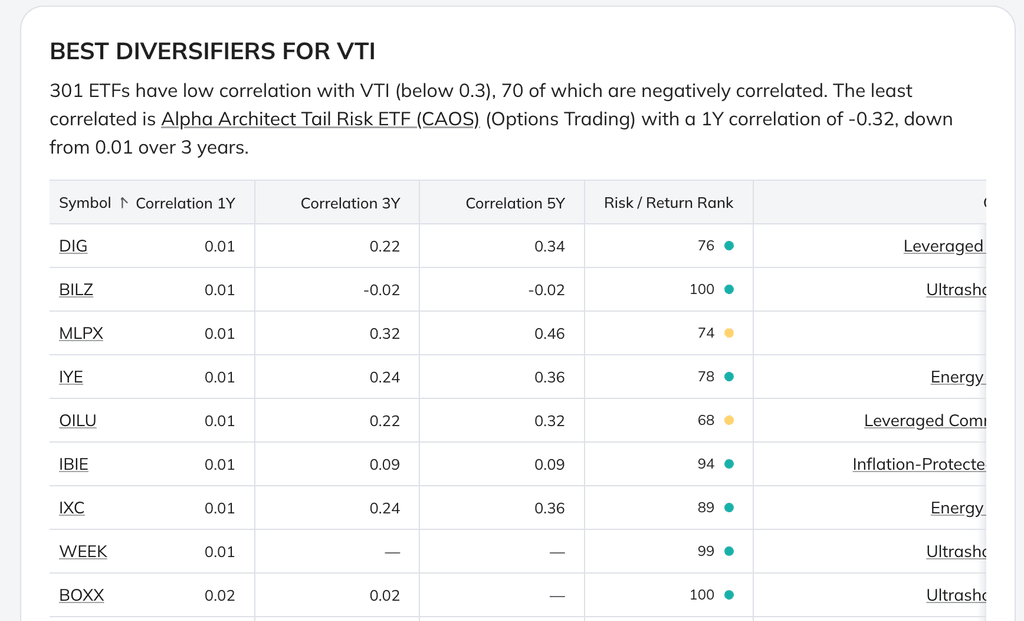
Every ETF and mutual fund on PortfoliosLab now has a Diversifiers page. Open a fund (for example, SMH) and you can see ETFs, mutual funds, and individual stocks that historically moved differently from it.
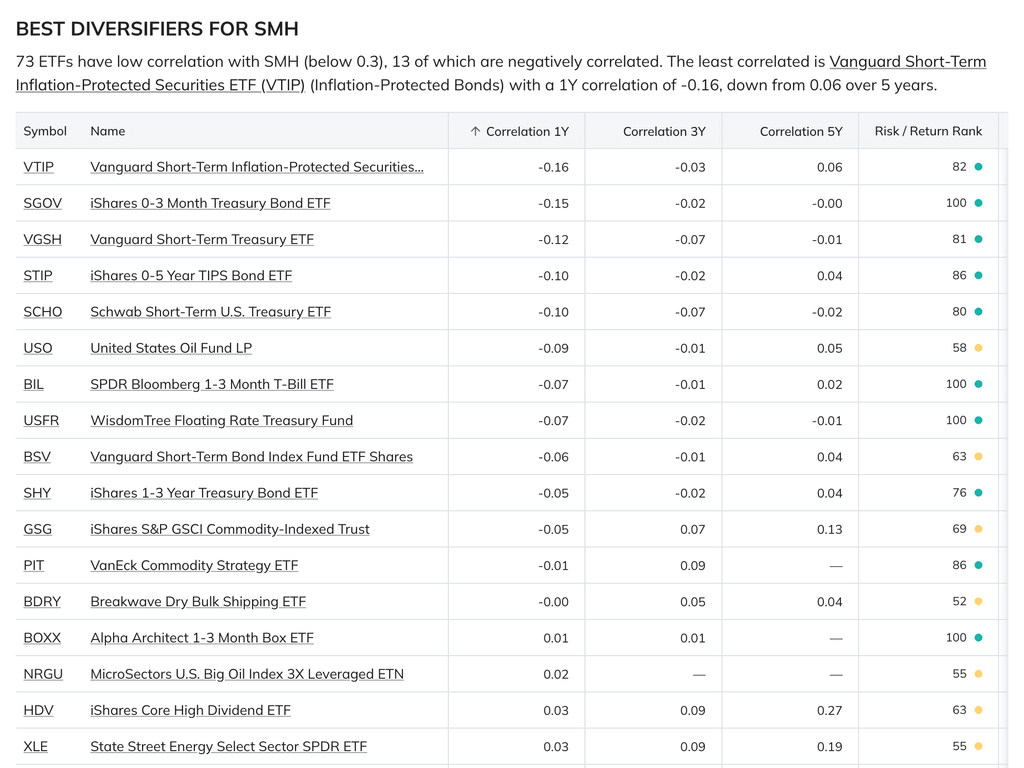
The page focuses on correlation across 1-year, 3-year, and 5-year windows. That matters because correlation is not fixed. Two assets can look independent over one period and start moving together later. Seeing several time windows helps you spot whether a diversifier is stable, improving, or becoming less useful.
Each page includes a data summary highlighting how many low-correlation funds exist for a given symbol, which asset categories dominate the list, and whether correlations are strengthening or weakening over time. For example, SMH currently has 73 ETFs with low correlation, 13 of which are negatively correlated — and the results go well beyond the obvious bond funds. Scroll past the treasuries and you will find oil, commodities, shipping, energy equities, and dividend funds that all move independently from semiconductors.
Low correlation alone is not enough. A fund can appear uncorrelated simply because it is poorly managed or drifting from its benchmark. Every result on the Diversifiers page includes PortfoliosLab's Risk / Return Rank, which scores funds on risk-adjusted performance. That way you are looking at assets that move differently and are still worth owning on their own.
For stocks, we show U.S. companies with at least $1B market cap that move independently from the fund you are researching, together with sector context and the same Risk / Return score.
Behind the scenes, we recalculate millions of correlation pairs daily across 3,000+ ETFs, mutual funds, and large-cap stocks. Every page reflects the latest available data, not a static snapshot.
Why this matters
Having many positions is not the same as being diversified.
You can hold five large-cap growth ETFs and still have one big bet. You can add another fund that looks different by name, but behaves almost exactly like what you already own. Your broker will show another line in the account. It will not tell you whether the new position actually reduces portfolio risk.
Diversifiers starts from the asset you already know and answers the next question: what can I pair with this that brings a different return driver?
That is useful when you are building a long-term portfolio and want fewer assumptions. Not "I think this should diversify me", but "this has historically moved differently, and I can see how stable that relationship has been."
A few ways to use it
Complement a core holding. You hold a broad U.S. equity ETF and want to add something that is not just another version of the S&P 500. Open its Diversifiers page and look for funds with consistently low correlation across multiple periods.
Find independent stock ideas. You want stocks that behave differently from a fund you own. Use the low-correlation stocks table as a starting point, then compare anything interesting before adding it to your portfolio.
Already checked a fund's Alternatives? Diversifiers answer the opposite question — not what to swap, but what to pair.
Availability
Diversifier pages are live for every ETF and mutual fund on PortfoliosLab. Free users can preview the top results. Pro users get full ranked lists with correlation trends across 1Y, 3Y, and 5Y.
2 comments
2 replies
Sort by
last mo.
last mo.
Hi, thanks for the heads up. The table lock behavior has been fixed now.
Reg correlation values, could you give an example? I see there are '-' in the table, where there is not enough overlap to calculate correlations: